Skip to content

Month: February 2026

NOT BLOOMING WHERE YOU’VE BEEN PLANTED

Why Sometimes You Need to Uproot Yourself

When I was married to my abusive husband, who was also my pastor, I read my Bible daily and worked through countless self-help books on marriage and becoming a better wife. I applied everything I learned. Yet nothing changed — at least not in the way I hoped. I wanted to see a man who valued me enough to stop his abuse. I didn’t understand then that I had to love myself first.

When I finally did start loving myself, transformation began. But it wasn’t him who changed — it was everything else. I saw my own worth. I recognized that I deserved better. I realized I didn’t have to endure the yelling, screaming, and berating anymore.

He never changed, but I did. And something else happened, too: I threw out those self-help books. I got rid of them and refused to read them again. I was angry. They hadn’t worked, and I blamed them for keeping me trapped in that marriage.

For a while, I even rejected anything religious, including the Bible. But one morning, I woke up and realized that none of it was God’s fault. I had made my own choices — that free will we all have. Though I felt forced to stay, I wasn’t literally in bonds or shackles.

When I began writing my memoir, Not What God Promised, I returned to those books to understand myself better and why I’d stayed so long. Reading them made me physically ill, thinking, puke, I can’t believe I tried this.

Now, over 11 years after my divorce, those books still sit on my shelf. I kept them as a reminder of who I was. And I’m about to celebrate the 8-year anniversary of my marriage to my best friend — the one who loves me regardless of how prickly perimenopause or menopause has made me.

This man has walked with me through the worst times of my life: learning to parent a child who was harmed while parenting the child who caused harm, losing my son to suicide, and going through menopause more than once — yes, that’s actually a thing. If you use Hormone Replacement Therapy and those hormones wear off, you experience peri and meno all over again. Not fun for anyone around you.

Today, when I open those same books, I think, “This is actually good stuff.” I read them with a completely different mindset now. Before, I believed that if I changed or became perfect, my narcissistic abuser would change too.

Now I read them, knowing that anyone can benefit from self-help, but I don’t do it to change my husband. Instead, I want to implement things I’d forgotten or taken for granted — like reminding him how much I appreciate and respect him. I do it because I love him and genuinely want him to know how much he means to me.

A plant can have strong roots, healthy leaves, and all the potential in the world, but if it’s planted in toxic soil, denied sunlight, or constantly trampled, it won’t thrive. No amount of watering or fertilizing can overcome a fundamentally hostile environment. The plant doesn’t fail because it’s weak — it fails because it’s in the wrong place.

But take that same plant and move it to healthy soil with light, space, and protection. When you fertilize it, it flourishes. Nothing about the plant changed. The difference was the conditions surrounding it.

You and I are the plant. These books are the fertilizer. This explains why so many Christian people turn to atheism and similar paths. Those books weren’t useless. They were simply being applied in an environment where growth was impossible.

I was trying to nurture something in soil poisoned by abuse. My brain associated those books with pain and trauma.

They tell you to “bloom where you’re planted.” That’s a lie designed to keep you stuck.

Now, in healthy soil — with a partner who waters rather than withers me — those same books finally make sense. I no longer keep them on my shelf as monuments to my pain. They’re proof that the right tools in toxic conditions can’t save you. The bravest thing I ever did wasn’t trying harder to bloom in poison. It was ripping myself out by the roots and replanting somewhere I could actually thrive.

I was never the problem. The soil was. And no amount of positive thinking, prayer, or self-improvement books couldchange that.

Sometimes you don’t need better fertilizer. You just need to get the hell out.


NOT BLOOMING WHERE YOU’VE BEEN PLANTED was originally published in Reaching Hearts on Medium, where people are continuing the conversation by highlighting and responding to this story.

Leave a Comment

A Morning Poem

Ai generated

I “demise”,

My word for the day.

Perhaps great sleep,

Would give me

something better to say.

My thoughts are disintegrating

From the time I get up.

I insist on silence

Til I see the bottom of my cup.

I’m a casualty of Insomnia,

and endless nights.

It’s the fuel for

The majority of my writes.

Quietly, I evaporate into my work,

Occasionally browsing Substack,

I lurk.

Ahhh, I’m no longer asleep,

Coffee does revive.

Instead of dying,

I now feel alive.

Yoli Kae

1 Comment

The Mercy of Pain

Surviving My Son’s Suicide

They say it was never intended for a child to go before a parent, and she thinks that is because when they do, a part of that parent goes with them. There’s a hole.

Children know their parents will go someday, and they anticipate it — not in an excited way, but in a knowing kind of way.

But you never anticipate the death of your child, not unless you are told it’s inevitable and beyond your control.

And she knows there are parents who have lost children to sickness and health reasons, but for those of us who had healthy children, who weren’t expecting or anticipating this, it has taken something from us. No, she is not saying that her grief is any worse than theirs, or yours. It is and was nearly the destroying factor of her life, and this is what she is writing about.

Only those who choose to resist the destruction can survive.

She saw him lying there, white, cold, hands in his lap, feet crossed. Like he posed before he did it. Mouth open, eyes closed, breathless. Although there was blood, the only thing she could see was the lifeless body of her baby.

Her baby was hoisted on a stretcher and wheeled up a rocky hill into an ambulance with no need for the siren. Only lights for this ride to the morgue.

Everyone asked her if she needed an ambulance. She wondered why they kept asking her that. She was still standing, but she was only existing in their reality. For she was living a different one. The reality she was experiencing was different from theirs. Her reality was a vortex sucking her down into a dark abyss.

She looked for a note. She searched. Where is it? There has to be something. Some explanation. Some goodbye. Some why. But there was nothing. Just his body and the silence.

When the coroner said he found one, she didn’t believe him. She thought maybe he was just being kind, trying to give her something to hold onto. Trying to make it easier. As if anything could make this easier. As if a note could explain why her son was cold and white and gone.

Later, she realized he was right. There had been a note. But in that moment, standing there, her reality splitting in two, she couldn’t trust anything. Not even mercy.

She could feel her body sob. She remembered the other mom on the other side of town who lost two sons the night before. Then she, not wanting to feel sorry for herself, felt sorry for the other mom, as if maybe this sympathy could hold her in place, keep her tethered to this world, keep her from the descent into hell.

“Sir, do you think she needs an ambulance?”

Why do they keep saying this? She is not crazy. She only just seen the cold, white body of her son. She only wants the comfort of her own bed, not the bright lights of a hospital room. What did they think taking her to the hospital was going to fix? Was it because she couldn’t stop sobbing?

Her sobs are uncontained. She didn’t care. She didn’t even try to stop. This was too painful to hold in. After all the things she had been through, this was the very straw trying to break the camel’s back. This is the thing that was going to take her under, the thing that tried the hardest to destroy her.

And she knew that.

So she did not try to contain the pain. She felt it. Every painful second of it. Every painful memory of it. Every bit of it.

The coroner gave her the name of a therapist, someone to talk to.

Okay, she says, being nice. Polite. As if politeness mattered when your child is dead. She took the paper with the number on it. She never called. The paper sat somewhere — a drawer, a purse, a void. She was numb. Too numb to reach out, too numb to ask for help, too numb to do anything but survive each day as it came.

The coroner tried to explain it away. He tried to say her child was troubled, but it didn’t matter what he said. It was still her child, and he was gone.

Time moved. Life went on, as it does, indifferent to grief. She started therapy 3 years later. Grandbabies were born. Relationships ended. New ones began. The world kept turning, kept demanding she turn with it. And somehow, she did. She survived each day, then the next, then the next.

Luke — Forever my baby

It’s been five and a half years since that day, and pain stops by to visit sometimes. And she still entertains him. She pulls his chair up next to grief, and they all have a cup of coffee together. They remember that day. They remember her son’s childhood times, the way he laughed, the things he loved. They reminisce about many things they are thankful for.

But they also talk about the other parents — the ones still in the early days, the ones who can’t breathe, the ones who think they won’t survive this. They talk about how to reach them, what to say, and what not to say. They talk about turning this unbearable thing into something that might help someone else make it through.

She sits with Pain and Grief. She doesn’t turn them away. And she’s glad. Even though she never really invites them, she’s always glad they come, thankful for their visits. For the way they’ve taught her that pain doesn’t have to destroy, that grief can become purpose.

Mostly, she’s thankful that pain showed mercy and didn’t destroy her, but instead became her friend, her teacher. Guiding her toward helping others find their way through the dark.


The Mercy of Pain was originally published in Women Write on Medium, where people are continuing the conversation by highlighting and responding to this story.

Leave a Comment
When Abuse Felt Like Safety (The 5th Red Flag)

Why We Run Back to the Red Flags

It’s Not God’s Fault — Red Flag Series

We’ve all heard the advice: “When someone shows you who they are, believe them.” It sounds so simple. So why, when we finally get away from a toxic situation, do we often find ourselves running right back into the fire?

In this post, I share a story I’m not proud of, but one that I know many of you will recognize. It’s the story of a night when fear overrode my logic, and a familiar demon felt safer than an unknown threat.

The Night the Shield Came Down

I was at a high point, just promoted to manager at the dry cleaners, but a low point emotionally. I was exhausted and lonely, living in a house that felt far too vulnerable, with its glass back door and no curtains.

When an intruder began tapping on that glass late one night, threatening to break in, my world shattered. The police came and went, but the safety didn’t return. In that moment of raw, adrenaline-fueled terror, I didn’t call my parents. I didn’t call a friend.

I went to Preacher’s house.

I went back to the lion’s den because I knew exactly how that lion bit, and in that moment, that felt more “manageable” than the stranger at my door.

The Illusion of Being “Chosen”

When I arrived, I was met not with comfort, but with coldness. Preacher didn’t ask if I was okay; he critiqued my appearance and told me he had been out with another woman.

When I told him I was thinking of moving away to start over, he didn’t support me. He attacked the idea, framing my independence as a mistake. Then came the hook — the words every trauma-bonded person longs to hear:

“Take me with you. There’s nothing here for me.”

In that moment, the red flags turned white. I felt special. I felt like the “winner.” I didn’t know then that he wasn’t choosing me because I was special; he was escaping a pregnant girlfriend and a life of responsibility. He was looking for an exit, and I was his getaway driver.

The Science of the “Relapse”

Why do we do this? Why do we return to people we know are dangerous?

It’s not because we are weak or unintelligent. It’s because a crisis hijacks the brain.

When we are in a state of high stress, our “logical brain” (the prefrontal cortex) goes offline. Our “survival brain” (the amygdala) takes over. This part of the brain doesn’t care about long-term health; it only cares about immediate relief.

To your nervous system, familiarity equals safety, even if that familiarity is a toxic relationship. This is called a Trauma Bond. We aren’t looking for love; we are looking for a “regulator” — someone to stop the current shaking, even if they are the ones who caused the earthquake in the first place.

How to Protect Yourself

Most “emotional relapses” happen when we are **H.A.L.T.**ed:

  • Hungry
  • Angry
  • Lonely
  • Tired

I was all four that night. If you find yourself reaching for a “red flag” person, stop and check your vitals. Are you scared? Are you exhausted? If so, you aren’t making a choice out of love — you’re making a choice out of survival.

Closing Thought

We ignore red flags because familiar chaos feels safer than unfamiliar peace. But remember: A familiar fire will still burn you.

(Click here for your Free Guide for Identifying Red Flags)

Listen to the full episode of It’s Not God’s Fault on your favorite podcast platform.

https://open.substack.com/pub/yolikaereynolds/p/when-abuse-felt-like-safety?r=2vce9i&utm_campaign=post&utm_medium=web&showWelcomeOnShare=true

Next Week on the Blog:

We’re diving into a red flag many of us overlook: How he treated his mother. The ultimate mirror of how he would eventually treat me.

Leave a Comment

Learning to Stay Present as Time Speeds Up.

When aging feels personal, time feels fragile — and healing teaches us how to live anyway.

“He has started shaving.” My daughter announced after sending me the link to my grandson’s basketball photoshoot.

“Oh my,” is all I can say to the reality that life is moving far too fast.

My first grandson — the one who made me a Nina — is thirteen. He’s shaving his mustache.

I updated her on her younger brother, who is only three years older than her son. I always knew I would have several children and grandchildren someday, but I never imagined I would be parenting a teenager at the same time my daughter was.

We exchange a few teasing remarks about our boys, and then she turns the reflections back on us. Her gray hair. My wrinkles. Who are we to talk about their shaving habits?

I sit back and try not to grow anxious as I face the reality that I am not getting any younger. And that scares me. I feel like I am running out of time, racing against the clock. Aging frightens me — not because of wrinkles or gray hair, but because of what time has already taken.

For some, accepting aging might be easy. But for those who have survived trauma, loss, and major life upheaval, aging does not feel practical. It feels personal. It feels like time is speeding up — like chapters are closing and fewer days are left.

If you were busy surviving—parenting, enduring, rebuilding, or grieving—you might notice time passing faster. Part of you might think:

I just got here. I just started living. And now I am already old.

There is a kind of loss that permanently alters how time moves. When you have buried a child, time is no longer neutral. Every birthday, every year, every wrinkle begins to whisper:

Life is fragile.
Nothing is guaranteed.
This could vanish in a minute.

Culture teaches us that youth is valuable and aging is decline. The older person is invisible. But that is propaganda, not truth. It exists to sell fear — especially to women. So when we feel anxious about aging, part of that fear is cultural programming.

And yet, when you have done deep healing work, life often gets better. Clearer. Stronger. Because you know who you are. You know what you will not tolerate. You know how to tell the truth. And you know how to love without disappearing.

I recently encountered a Buddhist teaching that challenges me — not because it is bleak, but because it refuses comfort. I read it with resistance.

I am of the nature to grow old;
there is no way to escape growing old.
I am of the nature to have ill health;
there is no way to escape ill health.
I am of the nature to die;
there is no way to escape death.
All that is dear to me and everyone I love are of the nature to change.
I am the owner of my actions, heir to my actions…

— Upajjhatthana Sutta (Anguttara Nikaya, Pali Canon)

I do not find peace in these words yet — but I find truth.

So here are the steps I am taking today.

When fear says, “I am getting older,” I answer with:

I am finally living in my own skin.
I am finally choosing myself.
I am finally free.

And when the fear hits hard, I return to the present with a simple grounding practice.

Putting my hand on my chest.
Breathing in.
I say quietly:

I am here.
I am alive.
I am still becoming.

I’ll do it three times.

As it brings me back from future panic into present life.

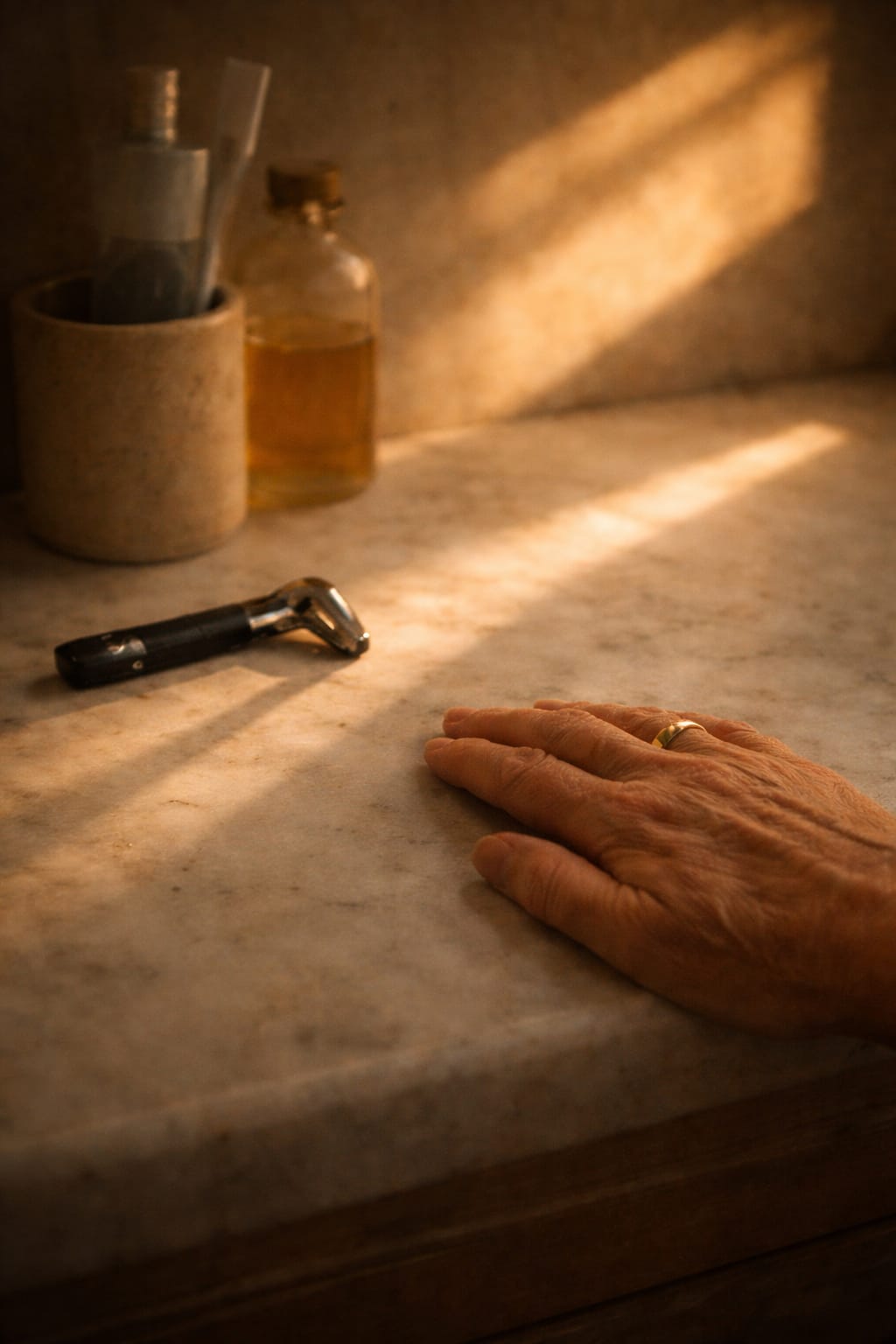
I am still becoming—no matter how many razors are in the house. And no matter how hard I try to remain 37.


Learning to Stay Present as Time Speeds Up. was originally published in Women Write on Medium, where people are continuing the conversation by highlighting and responding to this story.

2 Comments

Afraid Even After Leaving —The 4th Red Flag

How Fear Followed Me Into New Love

Leaving an unhealthy relationship does not automatically make you free.

Sometimes, the body leaves first.
The mind takes longer.

After separating from Preacher, I made it known that I was single again. Before long, I was asked out by someone I had known for years.

I will call him Liam.

We had gone to school and church together. I had admired him for a long time. He was kind, respectful, and emotionally steady. He was safe.

A Date I Barely Remember

When Liam came to pick me up, I was nervous. Not because of him, but because of Preacher. I was afraid he would see us. Afraid we would run into him. Afraid of what he might do.

The entire night, I kept looking over my shoulder. To my shame, I do not remember much about that date. I remember fear.

Fear of being seen.
Fear of being punished.
Fear of consequences that no longer made sense.

Living in Hiding

When Liam brought me home, I asked him to park on the other side of the apartment complex, just in case Preacher drove by. It probably looked irrational. It was not.

I remembered the story about the gun. I remembered the rage. I was trying to protect him.

Trauma does that. It convinces you that danger is everywhere, even when the threat is gone.

Telling the Truth

Eventually, I told Liam that I was afraid. I told him about Preacher and about what I feared might happen.

He listened quietly.

Then he asked, “Are you still seeing him?”

“Well, no, but…”

“Then what are you worried about?”

“He has a temper,” I said.

That was all I could explain at the time.

How Safe Love Responds

Liam leaned in and kissed my cheek. He hugged me. He did not pressure me. He did not minimize my fear. He did not try to control me.

He was gentle.

That should have felt good.

It didn’t.

It felt unfamiliar.

Letting Go of Something Good

I told myself Liam was too good for me. That he deserved better. That I would only bring him pain.

I thought I was being selfless.

But I was abandoning myself.

I lived by the quote, “If you love something, let it go…”

So I let him go.

He tried to call.

I did not answer.

That was the last time I heard from him.

What That Choice Really Meant

At the time, I believed I was being mature.

Looking back, I see that I was traumatized.

I had learned that love was dangerous. I had learned that closeness led to harm. So when something felt calm and respectful, I did not recognize it as safety.

I chose loneliness instead.

Why I Ignored the Red Flags Even Then

For a long time, I thought something was wrong with me. Why did I ignore warnings? Why did I doubt safe people? Why did I stay afraid even after I left?

Now I understand.

We ignore red flags because familiarity feels safer than peace. Chaos feels normal when it is what you know. Trauma trains you to survive, not to evaluate. You stop asking, “Is this healthy?” and start asking, “How do I keep this from getting worse?”

Hope edits reality. You focus on who someone was at the beginning, or who you believe they could become, rather than on who they are showing you they are. Empathy gets weaponized. Instead of asking whether something is acceptable, you ask what happened to him. You turn danger into a backstory.

Self-doubt silences instincts. After enough criticism and gaslighting, you stop trusting your own body and your own voice. Fear of being alone becomes louder than fear of being harmed. Trauma bonds begin to feel like love.

Add faith to that, and endurance gets confused with devotion. Abuse grows slowly, so each step feels “not that bad” compared to the last. And sometimes, the truth is simply too painful to face all at once, so the brain protects you with denial.

None of that means I was weak.

It means I was human.

The Love We Think We Deserve

Stephen Chbosky wrote, “We accept the love we think we deserve.”

I believed I was attractive.
I believed I was capable.

I did not believe I was worthy of calm, steady love.

What This Taught Me

Leaving abuse does not end the story.

It begins the work.

It means learning to recognize safety.
Learning to trust your body again.
Learning to listen when something feels wrong.
Learning that love need not hurt.

Red Flags After You Leave

Fear is one of the biggest reasons we keep missing red flags.

When you are afraid of being alone, afraid of starting over, afraid of trusting again, you stop asking, “Is this healthy?”

You start asking, “Can I survive without this?”

That question changes everything.

It makes you tolerate what you should not.
It makes you doubt what is good.
It makes you return to what is familiar, even when it hurts.

Learning to recognize red flags is not just about watching other people.

It is about noticing what happens inside you.

When you feel anxious.
When you feel small.
When you feel pressured.
When you feel like you have to disappear to be loved.

Those are signals.

Those are warnings.

If This Sounds Like You

If any part of this feels familiar, nothing is wrong with you.

You are learning.

You are becoming aware.

You are breaking patterns that were never your fault to begin with.

And that matters.

This post is part of my “Red Flags” series. In the next post, I will share what happened when fear drove me back to the person who had already hurt me, and why danger started to feel like protection.

Free Red Flags Guide

Leave a Comment

Living in 15% of the Cup: How Fawning Makes Us Small in Abusive Relationships

A powerful metaphor from Ingrid Clayton’s book helped me finally understand the quiet erosion of my identity—and begin to reclaim space for myself.

Many of us have learned to shrink ourselves just to survive—especially in relationships where love is conditional or controlling. In reading Ingrid Clayton’s book on fawning, I found language for experiences I never knew how to describe. One metaphor in particular—the “cup”—helped me understand just how imbalanced things had become.

“Nobody wants to make themselves small, minimize their feelings, or tolerate abuse. We do it out of necessity, to preserve our relationships or survive our environments.”
—Ingrid Clayton, Fawning: Why the Need to Please Makes Us Lose Ourselves—and How to Find Our Way Back

“Fawning is proportional. The relationship is a cup.”
—Ingrid Clayton

Imagine the relationship as a cup. In a healthy dynamic, both people have space to be seen, heard, and take up emotional room. But in abusive or codependent relationships, one person swells to fill most of that space, leaving the other compressed into whatever’s left.

A glass filled with layers of dark liquid on top and a creamy white layer at the bottom, placed on a light surface.

In abusive relationships, the abuser takes up most of the space—85/15—and we learn to live in what’s left. We minimize reality. We have toxic hope, thinking that if he would just do this, then it would be different. For me, I held on to the hope that if he just got a job, we would no longer be in poverty.

But when he got a job, it didn’t change his spending habits.

I held on to the hope that if he could control his anger, then everything would be better and we would get along. But when he stopped using his voice to yell, he still used it to diminish me. His anger looked “controlled,” but it was still there—in his eyes, his tone.

He no longer had to yell to get me to do what he wanted; I was already trained and conditioned to be his little submissive, fawning wife.

His “controlled” anger didn’t change the dynamics of the relationship.

I was little. He was big. And he had no intention of giving up any of his space in our relationship cup.

We can’t change someone else’s need to control, but we can start to question why we believe we must shrink to survive. Realizing this dynamic was painful, but it gave me language to begin reclaiming space in my own life.

Have you ever felt like you were living in just 15% of the relationship cup—shrinking yourself to fit someone else’s world? If so, you’re not alone. I’d love to hear your story.

If this resonates, I recommend checking out Clayton’s book, Fawning: Why the Need to Please Makes Us Lose Ourselves—and How to Find Our Way Back—it’s been a lifeline for me.

Leave a Comment

The 3rd Red Flag — When Love Became Control

After the restaurant incident, something shifted.

On the surface, things looked better.

Preacher began showing interest in my son. He treated him like his own. He played with him, talked to him, worried about him, and took an active role in his life. He even corrected me when I drank or used drugs around my son.

At the time, that felt like love.

I did not understand then that control often enters our lives disguised as care.

One night, when my son had to go to his dad’s for his weekly visitation, Preacher sat in the rocking chair in my bedroom and cried.

He said, “It isn’t fair. He is being torn away from us. He’s going to be confused. It’s going to mess him up. He’s supposed to be my son. I’m supposed to be his dad.”

It was emotional. It was convincing. It felt sincere.

I remember thinking, He loves my son. He will be a good father. We will be a family.

What I did not see was that he was positioning himself as essential. As irreplaceable.

Not long after that, I won full custody of my son. His father stopped showing up for court dates. Soon after, Preacher and I moved in together.

And slowly, my world began to shrink.

We fought about money, even though we had enough.
We fought about friends, until I stopped seeing them.
We fought about cars.
We fought about my job.
We fought about phone calls with my mom.
We fought about how long I talked to anyone.

Nothing was neutral anymore.

Everything was monitored.

Every choice required justification.

One night, our fighting became so intense that neighbors called the police.

In his rage, Preacher grabbed my son’s small rocking chair and smashed it over the kitchen table. Wood flew through the air like oversized toothpicks. When that was not enough, he shoved over a shelf that held my favorite things.

I believe he chose it because he knew it would hurt me. The next day, he brought flowers.

That became the pattern. I learned to focus on the apology instead of the violence. That is trauma bonding. It trains you to cling to remorse and ignore harm.

Preacher was more than a foot taller than me. When he was angry, he used that to his advantage. Sometimes he shoved me. Mostly, he used his words. He did not have to hit me. I was already afraid.

Eventually, something in me broke through. On the outside, it looked like I had left. But the control did not disappear. It followed me. I was physically gone. But emotionally, I was still trapped.

Control does not always sound harsh. Sometimes it sounds like concern.

“I’m just worried.”

“I’m protecting you.”

“You don’t need them.”

“They’re bad for you.”

“Why do you talk to them so much?”

If this is the only post you ever read from me, I want you to remember this.

Love should not make your world smaller.

It should not require you to shrink, stay quiet, explain yourself constantly, or give up pieces of your life to keep someone else comfortable. Real love does not monitor you. It does not isolate you. It does not punish you for having relationships, opinions, or boundaries.

If someone says they care about you, but you feel anxious all the time, that matters. If someone says they are protecting you, but you feel trapped, that matters. If someone says they love you, but you feel like you are disappearing, that matters.

It means your nervous system is telling you the truth. And you are allowed to listen.

You are allowed to question what feels wrong.
You are allowed to take space.
You are allowed to want peace.
You are allowed to choose yourself.

If you are in something that feels confusing, heavy, or unsafe, you do not have to figure it out alone. Talk to someone you trust. Reach out for support. Tell your story out loud.

You deserve relationships where you can breathe, grow, and where you can be yourself.

And if no one has told you this before, let me be the one to say it. You deserve better.

You are not asking for too much. You are asking for what is healthy. And that is okay.

This post is part of my “Red Flags” series. In the next post, I will share what happened when I tried to move on, only to have fear follow me.

Originally published at https://yolikaereynolds.substack.com on February 2, 2026.

Leave a Comment

Rage in Public: The 2nd Red Flag

When My Body Knew Before I Did

On our first date, nothing too dramatic happened. There was no yelling. No police. Just tension and fear. At the time, I did not know how much that moment would matter.

Preacher (my ex-husband) took me to a restaurant he had been bragging about for weeks. He was excited, almost proud, to show it to me. I went along hoping, quietly and desperately, for a night that felt normal, easy, and safe.

The restaurant was dimly lit, with dark wooden walls and the lingering smell of fried food and oil. It was not fancy, but it felt like a real date, something almost normal. I remember thinking that maybe this was the beginning of something good. We ordered our food and waited.

After about five minutes, he grew restless. He scanned the room and snapped, “Where is our food? What is taking so long?”

I looked around. Nothing seemed wrong. Other people were still waiting too. But something in his tone had shifted, and I felt it immediately. I took a sip of water and felt a lump rise in my throat. My fingers twisted my napkin. My body reacted before my mind understood why. There was a dark, threatening look in his eyes that unsettled me.

After fifteen minutes, he flagged down the waitress and asked about our order. When the food finally arrived, he stared at his plate in silence.

“This is not what I ordered,” he said.

It was exactly what he had ordered.

He picked up a fry, dipped it in ketchup, and dropped it back onto the plate. “I can’t eat this shit. This is repulsive.” His jaw tightened. He turned away from me, as if holding himself back from something much worse.

I sat quietly, picking at my food even though my appetite was gone. My stomach was tight. My chest felt heavy. I was no longer focused on enjoying dinner. I was focused on not making things worse.

I did not question him.
I did not challenge him.
I did not say anything.

I went still.

Looking back now, I recognize that response was a survival instinct. When someone’s anger is unpredictable, silence can feel like safety.

After pushing his plate away. He tossed some money on the table and walked toward the door.

That was the first time I followed him out of a building in one of his rages.

But it would not be the last.

Looking back, I can see I didn’t ignore that moment out of carelessness. I ignored it because of everything that had come before it. I had already survived one abusive marriage. I was raising a child. I was tired, lonely, and desperate for something in my life to finally work.

When you are exhausted like that, you do not walk away easily. You begin negotiating with reality instead. I told myself that every relationship has problems. That nobody is perfect. That at least he wanted me, at least he showed up, and at least he cared about my son. I was measuring him against my worst experiences, not against what I actually deserved. Compared to what I had already lived through, he seemed better.

Not healthy. Just better.

Part of me believed that if I handled things the right way, he would calm down. If I stayed quiet. If I did not challenge him. If I did not embarrass him. If I did not make things worse.

I believed peace depended on me.

That is a dangerous belief. It teaches you to manage someone else’s dysfunction rather than question it.

There was fear, too. Not fear of him yet, but fear of being alone. Fear of starting over. Fear of admitting I had made another mistake. Fear of disappointing people. Fear of being judged.

So I stayed quiet and hopeful.

Faith was mixed into it as well. I believed love meant endurance. That commitment meant patience. That walking away meant failure. So I spiritualized my silence. I called it grace.

In reality, it was self-abandonment.

I also did not trust myself. My first marriage had convinced me that my instincts were unreliable. That I was too sensitive. Too emotional. Too reactive.

So when my body whispered, “This is not safe,” my mind answered, “You are overreacting.”

And I listened to my mind instead of my body.

Now I understand.

I was not weak.
I was conditioned.

Conditioned to doubt myself.
To tolerate chaos.
To confuse tension with love.

That is not a character flaw.

It is survival.

That night, my body knew something my mind was not ready to accept. The lump in my throat, the tightness in my chest, the way my hands would not stop moving, all of it was information.

Fear is information.

We are often taught to ignore it. To be polite and compliant. To give people the benefit of the doubt. But when your body reacts like that, it is trying to protect you.

Mine tried.

I just was not ready to listen yet.

I understand now that public rage is not harmless. It is practice. It is a rehearsal for what will happen later, behind closed doors.

If someone is willing to humiliate waitstaff, intimidate you, or lose control in front of others, they are showing you who they are.

Believe them.

If someone makes you feel afraid in public, they will eventually make you feel afraid in private.

If you are reading this and recognizing yourself, I want you to know something.

You are not overreacting.
You are not dramatic.
You are not weak.

You are paying attention.

You deserve relationships that feel safe, calm, and steady. You deserve love that does not require you to disappear to keep the peace.

This post is part of my “Red Flags” series. In the next post, I will share what happened when concern turned into control and how love slowly became supervision.

Free Red Flags Guide

Leave a Comment