
Skip to content

Tag: CPTSD

CPTSD Tool-kit

Moving past trauma does not come from fixing the past or controlling emotions. It happens slowly by how we take care of ourselves in the present.

What we think about, how we talk to ourselves, and whether we choose to honor our exhaustion rather than punish our perceived failures.

People who appear more resilient are not untouched by hardship; they have learned ways to carry it without being consumed by it.

Four Things I do When I am Triggered:

  1. Breathe
  2. Check in
  3. Let it out
  4. Remind

Breathe

The first thing I do when I’m consumed with the past is breathe. Not the shallow, panicked breathing that comes naturally when you’re triggered, but intentional breathing. Deep inhales that fill my lungs completely. Slow exhales signal to my body that I’m not in danger right now.

This has to come first. It’s not optional. When my nervous system is activated, nothing else works. I can’t think clearly, and I can’t access the rational part of my brain. I can’t connect with the parts of me that need attention.

Breathing calms the nervous system down. It tells my body: I’m safe, and I can handle this.

Check In

Once I can breathe, I check in with the different parts of me that got triggered.

The parts of me that are still the little girl who survived trauma,  and the ex-wife in me who learned that abuse meant something, were fundamentally wrong with me. The old version of me, the mom, who feels guilty for everything. For the past, for staying in an abusive marriage for 24 years, and for things I can’t control. There are parts of me that are exhausted from trying so hard to be different, to break cycles, to heal.

I’ve learned in therapy that these parts all have something to say. They all need to be heard. And when I get triggered, it’s usually because one of them is scared or hurting and trying to protect me the only way they know how.

So I check in. I ask: which part of me is feeling this right now? What does she need? What is she afraid of?

Let It Out

After I’ve breathed and checked in, I need to let it out. The feelings can’t stay inside my body. They need somewhere to go.

Sometimes I journal. I write without editing, without trying to make it make sense. I let the fear, the guilt, and the helplessness spill onto the page.  I write about the abuse I survived and how it still haunts me. And I write about whatever might have triggered me that day. Even if it was only the dog getting into the trash.

Sometimes I talk to someone who understands, like my therapist or my husband. I say the things out loud that feel too big to carry alone. I let someone else witness my pain without trying to fix it or minimize it.

Just: I see you. I hear you.

Getting the feelings out doesn’t make them disappear. But it makes them manageable. It takes them from this overwhelming internal storm and gives them form, language, and a place to exist outside of me.

Remind

The last tool is the one I need most: remind.

When the old shame tries to convince me I should have healed enough by now to not get triggered, I remind myself:

I did the best I could with the tools and knowledge I had. And I’m doing the best I can now.

When I feel like I’m failing because I got derailed again, I remind myself that a brief moment of being consumed isn’t failure. It’s part of being human. It’s part of having a nervous system that remembers trauma. What matters is what I do after.

I also remind myself that I’m safe now. And I am loved.

Healing comes in waves, just like grief does. Sometimes the waves are higher and harder, like when an anniversary of trauma comes around, when my nervous system gets activated by something I didn’t see coming. Sometimes the waves are just ebbing, gentle reminders that I’ve been through hard things, but I’m okay now.

Self-help culture promises a permanent better. It sells the idea that if you do the work, use the right tools, and heal properly, you’ll reach a destination where you’re fixed. Where you don’t get triggered anymore. Where you’ve moved past it all.

That’s a lie. The truth is that healing isn’t reaching the shore. It has the tools to stay afloat. And it is the repetition of returning to these practices, not because you failed the first time, but because this is what healing actually

Leave a Comment


Positively Divine

What positive events have taken place in your life over the past year?

This year has been one of the most unexpected beautiful years of my life, full of surprises, healing, and quiet miracles I did not always see coming.

It began with the joy of the birth of grandchild number ten and the sweet anticipation of number eleven already on the way. Every new little heartbeat in this family reminds me how wide my world is and how love continues to grow around me whether I am ready or not.

Our third short-term rental went online and stays booked. It amazes me to watch what I dreamed of into existence, and watch it take off and thrive. There is a quiet pride in that, a feeling of finally seeing hard work turn into something real.

Then came Colorado. Two weeks of pure beauty, with every turn revealing something that made me pause and breathe a little deeper. I did not realize how much I needed that trip until I was standing there, surrounded by mountains that made everything inside me feel a little clearer.

But the biggest changes this year happened within me.

After years of gut problems, I finally discovered the physical cause. That alone felt like a breakthrough I had been waiting for far too long. Therapy opened an even deeper door. I began to uncover the emotional weight I had been carrying and the trauma that had settled into my body. I started learning how to set boundaries and how to listen to the parts of myself I had ignored. I connected with my inner child, the version of me who needed comfort and understanding, and I finally began to give her that.

Along the way, I started feeling more comfortable in my own skin. Not the person I thought I was supposed to be, but the person I actually am. This shift feels real, even if it is still unfolding.

And perhaps one of the most meaningful steps I am taking this year is working on my book proposal. I’m not  just dreaming about it, I’m doing it. This alone feels like reclaiming a part of myself I thought I lost.

When I look back, this year was not simply positive. It was transformative. It was a year of returning to myself in ways I never expected.

2 Comments

DON’T TAKE IT PERSONAL

Why You Take Everything Personally (And What No One Told You About It)

Let’s be real. You don’t just “hear” what someone says—you absorb it.
A sigh? You feel it like a slap.
A short text? Your stomach drops.
If they are quiet? You spiral.

Taking things personally isn’t a flaw—it’s a reaction to what you’ve been through…

Someone trained you to feel this way.

Maybe you were in a relationship like mine—one where your partner, or parents, made sure you were never really safe. Where you had to study their mood the way a sailor studies the sky.
Because one wrong word, one wrong look, could start a storm.

I know what that feels like.
To live in a home that felt more like a test.
To love someone who used your love against you.
To be blamed for everything—their anger, their silence, their outbursts, their boredom.

When you’re with an abuser, especially for years, you don’t just fear them—you become them in your own head.
You start criticizing yourself before they can.
You start shrinking your needs because it’s safer that way.
You start interpreting everything around you as a threat.

That’s why you take things personally.
Because you were trained to see danger in the subtlest shifts.

You were taught that mistakes mean punishment.
That emotions are weapons.
That love means walking on eggshells while setting yourself on fire to keep someone else warm.

So now, when someone gives you feedback, you feel attacked.
When someone pulls away, you assume it’s your fault.
When someone’s upset, you blame yourself.

But here’s the part you need to hear:
It’s not your fault.

You were conditioned to believe that your survival depended on reading people perfectly.
You weren’t being sensitive—you were being smart.
You were protecting yourself.
But now?
Now you don’t have to live like that anymore.

That voice in your head telling you “you messed up,” “they hate you,” “you ruined everything”—
That’s not your voice.
That’s theirs.
That’s the voice of the person who broke you down, not the one who gets to build you back up.

And you’re allowed to question it.
You’re allowed to replace it.
You’re allowed to heal—even if they never apologize.

So if you’re sitting there wondering why you take things so personally, let me say this:

You’re not crazy.
You’re not broken.
You’re carrying a survival instinct that once kept you safe—but it doesn’t have to run your life anymore.

You can learn to breathe again.
To trust again.
To love without fear.
To hear someone’s words without turning them into wounds.

You’re allowed to take your power back.

One truth at a time.

Leave a Comment

How to Recover After Someone Humiliates You

If something happened that left you shaky, ashamed, exposed, or suddenly doubting yourself, I want you to know this:

What you’re feeling is real. And it makes sense.

Most people have no idea what humiliation actually does to a person. They think it’s “just embarrassment.” They think you should shrug it off. But humiliation is a psychological wound. It hits the same part of your brain that reacts to physical pain. It knocks your confidence, your voice, and sometimes your sense of self out from under you.

And if no one ever taught you how to deal with this kind of emotional blow, you might be blaming yourself for a wound you never deserved.

Let’s walk through this slowly, in a way that makes space for your pain and gives you a way forward.


1. Something painful happened — you didn’t imagine it

Someone cut you down.
Someone used their words, tone, or power to make you feel small.
Someone spoke to you in a way that pierced straight through your dignity.

You weren’t “overreacting.”
You weren’t “too sensitive.”

You were caught off guard by a moment that should not have happened.

Humiliation exposes the person who delivered it — not the person who received it.


> “A painful moment happened to me. It does not define me.”


2. Your body responded because humiliation is a body-level injury

Most people don’t talk about this part, but humiliation hits the body first:

Your throat closes.
Your stomach flips.
Your face gets hot.
Your mind blanks out.
Your chest tightens.

This is your nervous system trying to protect you.

It doesn’t mean you’re weak.
It means you’re human.

Before you try to make sense of anything, let your body settle.

Try this:

Drop your shoulders

Loosen your jaw

Place your hand on your chest

Slow your exhale

Whisper, “I’m safe enough right now.”


You cannot think clearly in a body that feels attacked.


3. The wound came from the story your mind created afterward

There’s the event itself…
and then there’s the meaning your mind wrapped around it.

Humiliation tries to whisper things like:

“Everyone saw.”

“You looked foolish.”

“You should’ve known better.”

“They were right about you.”


But those thoughts aren’t truth.
They’re the bruise talking.

Say this gently: “The story I told myself was…”

Name it so it stops running the show in the dark.


4. Humiliation makes you want to hide — but hiding keeps the wound open

After you’re hurt like this, the instinct to disappear is strong.
You avoid eye contact, replay the moment, pull your energy inward.
You shrink as if shrinking will protect you.

But hiding is exactly what keeps the wound tender.

You don’t have to tell the whole story.
Just start with one simple sentence:

“Something happened that made me feel small.”

Speaking it breaks the isolation humiliation depends on.


5. Reclaim your authority over what the moment meant

When someone cuts you down, their voice can become louder in your head than your own.

But your dignity is still yours.

Say: “I get to decide what this means.”

Not them.
Not the moment.
Not the fear that followed.

You.

Every time you say it, something inside you stands a little straighter.


6. Give yourself what you needed in that moment

Ask yourself: “What did I need right then?”

Respect?
Understanding?
Protection?
Someone to step in?
Someone to say, “That wasn’t okay”?

Now ask: “How can I give even a small piece of that to myself now?”

This is what begins to repair the psychological wound.


Here’s the truth I want you to carry with you

You are not the smallness someone tried to put on you.
You are not the version of yourself their words tried to create.
You are not the moment that knocked your voice out of your chest.

You were wounded.
And wounded people don’t need shame — they need understanding, space, and a way back to themselves.

This is that way back.

👉 Download the Humiliation Recovery Guide

Leave a Comment

Why Happiness Makes You Nervous

For the girl who thinks the tightness in her chest is normal

Good times make you nervous, don’t they?

You don’t call it fear—you call it “being cautious,” or “not getting your hopes up.” But the truth is quieter: you’re not used to peace. For so long, love has felt like tension, panic, apologizing, overthinking, and walking around someone else’s moods like they’re landmines.

So when something finally goes right… Your whole body glitches.

You look around, waiting for the explosion.
You wait for the tone in his voice to shift.
You wait for the moment he decides you’re “too sensitive,” “too emotional,” or “too much.”

And if nothing happens right away, your brain fills the silence with dread: Is this the part where it all turns again?
You don’t trust happiness—not because you’re broken, but because you’ve survived too long without it.

Girls like us learn early that peace feels like a trap.
A setup.
A calm before the next storm.

No one told you that real love isn’t supposed to feel like bracing for impact.
No one told you that safety isn’t the same thing as “keeping the peace.”
No one told you that if your body relaxes only when he isn’t home… that’s not comfort. That’s survival.

Listen, sweetheart—if happiness feels foreign, it’s not because you’re incapable of it.
It’s because someone taught you to expect pain.

And here’s the part I wish someone had whispered to me sooner:
You don’t have to keep living in the story where fear feels like love. You don’t have to keep shrinking yourself just to fit into a relationship that was never safe to begin with.

Real peace doesn’t make you nervous.
Real love doesn’t make you flinch.
And real happiness doesn’t feel like a setup—it feels like finally coming home to yourself.

You deserve that kind of happiness.
And I promise… it won’t explode.

When someone ties despair to God Himself, it buries you in a deeper kind of fear. You stop dreaming. You stop believing in the better. And every time life gets quiet, you brace yourself, because you know the calm never lasts.

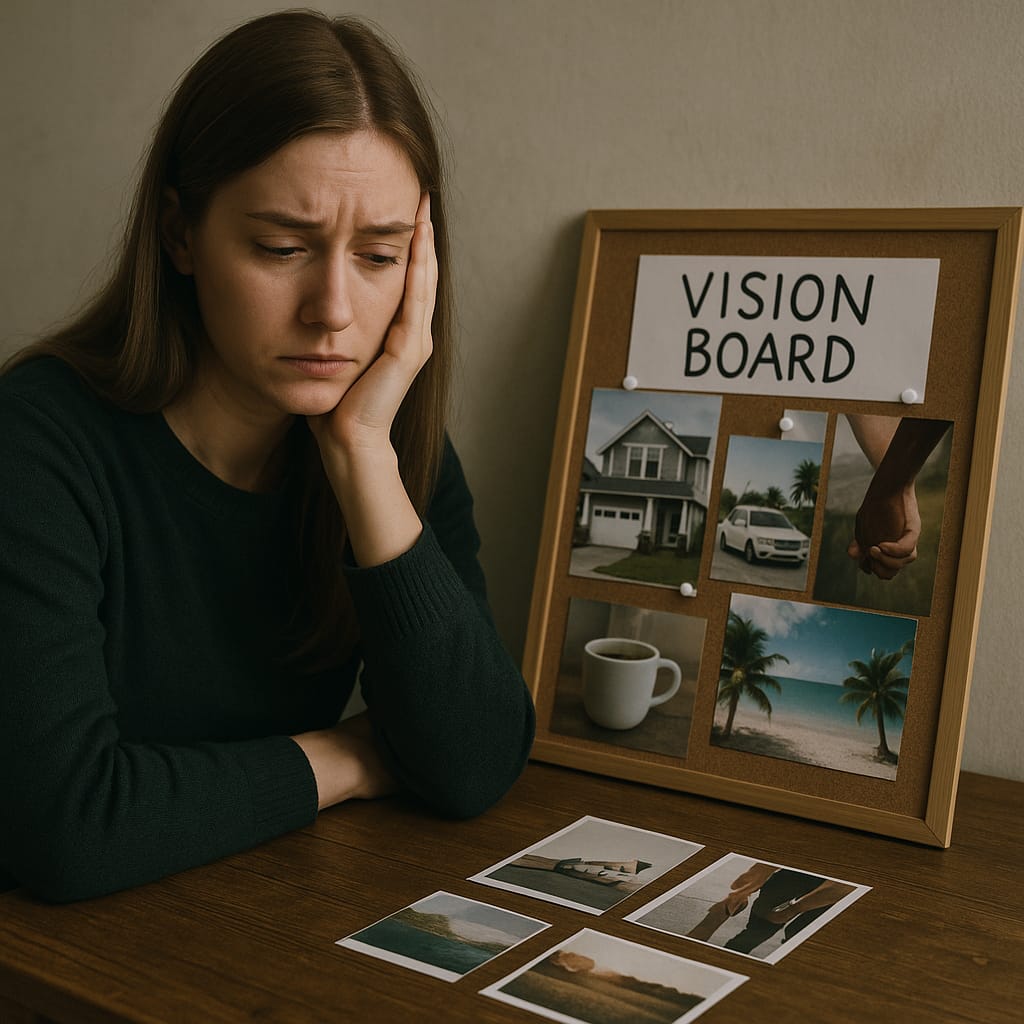
I remember once, after one of our rare calm seasons, we tried to dream again. We made a little vision board together — nothing extravagant, just things a normal couple would hope for. A peaceful home. A reliable car. A future that didn’t feel like walking through broken glass.

But his face went dark, the way it always did when anything felt too good.

He looked at me and said,

“God hates me. We will never get any of this.”

And just like that, the air changed.
The hope drained out of the room.
My body learned — again — that peace wasn’t safe, and happiness wasn’t to be trusted.

Leave a Comment

That day

That day.

I remember exactly where I was standing. 

The time of day, the lighting in the house. 

It was evening, so, the sun was lowering in the sky casting shadows in that kitchen. 

I stood by the enormous stainless Steel fridge. 

I was wiping the microwave when I asked her, “so you saw it?” 

She shook her head “yes”.

 I said, “ewww… Gross! That must have been scarring! Those things are ugly!” (Referring to her oldest brothers penis). 

Right then I knew I had to ask the next question, even though I didn’t want to know the answer. 

“So, did he try to stick it in? In you?” 

Her eyes never looked up at me, as she said, “yeah, I told him to stop because it hurt but he said he was ‘almost there’. ”

I know my facial expressions changed. 

I now had information that could put my son away in prison for years.

I am in shock. 

She still isn’t making eye contact with me, but she trusted me enough to tell me the truth. I couldn’t let her down.  I didn’t.

I asked her where and when and got more details. 

One thing is for sure, I will never forget that day. The place, the time nor the time of year. 

That day. The beginning of many that would send me and my family down an emotional roller coaster of a journey. 

That day. That knowledge. We will never forget.

That day.

1 Comment