Parenting Both Sides of Sibling Sexual Abuse

Parenting Both Sides of Sibling Sexual Abuse

A Message From The Hummingbird

I am the mom on both sides of a complicated story. Loving one child who was sexually abused and loving the one who caused the harm.

There is no road map for navigating something like this. No clean language. No version of the path forward that does not cost something deep and painful. Some days it feels like my entire role is simply to remain standing when I feel like falling and to stay present when everything in me wants to hide. Functioning while absorbing this kind of shock is a challenge in itself.

And yet, here I am. Learning how to love without chasing, how to hold boundaries without disappearing. How to remain myself even when relationships have changed form in ways I would have never imagined.

Lately, I have been thinking about the hummingbird.

A hummingbird migrates thousands of miles relative to its size. It burns enormous energy simply to stay alive. Even hovering in place takes constant effort. It does not rest the way other birds do. It must keep moving its wings just to remain where it is.

That feels familiar.

As parents and humans navigating trauma, we expend energy just to stay standing and emotionally present. We hover. We show up. We pay attention even when everything in us wants to give up. We absorb pain and strain quietly and keep going. Like the hummingbird, we need nourishment, spiritual and emotional, because the work of staying present is exhausting.

The hummingbird symbolizes resilience after hardship. It represents the return of joy and lightness, not because things become easy, but because survival itself requires strength. It reminds us that connection does not require possession, love does not require obligation, and presence does not require control.

We can love deeply and still protect ourselves. We can hold grief and hope at the same time. We can remain connected without losing who we are, and we can stay in place without collapsing.

If you are hovering right now, barely holding yourself together, that is worth remembering! Your quiet strength counts! The energy you put into staying present matters!

Even in the most challenging seasons, strength can exist. You are not failing, you are surviving. And sometimes that is the bravest thing any of us can do.

When Doing the Right Thing Still Makes You Feel Like the Villain

When Doing the Right Thing Still Makes You Feel Like the Villain

A story about family, guilt, and the cost of choosing someone’s peace and safety

This year, I set a boundary with my parents.

We didn’t go to their house for Thanksgiving. We had it at ours instead. That might sound small to someone outside the situation, but it wasn’t. It carried years of pain, silence, and choices that should never have been mine to carry.

It wasn’t even about me this time. It was about my daughter.

There’s a story I’m not going into here, but I’ll say this much. My daughter was violated by a family member, their grandson, my son. He’s in prison now for what he did to her. But my parents still choose to stay in contact with him.

She was the one who said she didn’t want to go. She didn’t want to sit in a place that still protects the person who hurt her. And I decided to support her, choose her, and stand on her side.

It was the right thing. I know that. But it didn’t stop the fallout.

My mom didn’t speak to me for a whole week. My dad turned on the guilt, the blame, and the disappointment. Like I was the one punishing them. All I did was protect my daughter from the people who made her feel betrayed.

And still, I spiraled. I second-guessed myself. I wondered if I was being dramatic, if I had taken it too far, if I was being cruel by drawing a line.

That’s how deep the conditioning goes. That’s how beating yourself up becomes your favorite hobby.

You protect your child. You do what you know is right. And then you punish yourself for it.

Here’s how that cycle works. Here’s how the guilt gets under your skin and stays there, even when it shouldn’t.

1. You confuse guilt with being good.
You grew up thinking that if it hurts, it must mean you care. If you carry the guilt long enough, maybe it proves you’re the better person. Perhaps it means you’re nothing like the ones who hurt you. So you hold it. You nurse it. You call it empathy, but it’s not. It’s grief. It’s fear. It’s survival mode, you never got the chance to grow out of.

2. You turn on yourself before anyone else can.
It’s safer that way. You blame yourself first. You get ahead of the punishment. You run the worst-case scenario before it even happens. That way, if someone does get mad, you’re already halfway into self-destruction. You don’t have to be blindsided. You’re already bleeding. You call it control, but it’s fear disguised as preparation.

3. You were trained to carry the weight for everyone.
Keeping the peace was your job. Making things easier and smoothing things over. So when you finally make a decision that protects someone else, someone innocent, someone hurt, it still feels like betrayal. It feels like you’re letting everyone down, even when you’re the only one standing up for what’s right.

4. You think beating yourself up makes you accountable.
You think that if you suffer enough, it proves you’re not careless. That you’re not cold. That you understand the impact. But accountability is not self-punishment. It’s not turning your own heart into a punching bag. Accountability means standing in your truth and owning your choices, even when they hurt, even when you’re alone in them.

You can know something is right and still feel crushed by the guilt of doing it. That’s the part people don’t talk about.

The pain of healing is that it often makes you look like the villain to the people who benefited from your silence. And the reflex to beat yourself up is strong. It feels like the only way to keep the peace with yourself when everyone else is pulling away. But beating yourself up is not the same as being good. It’s just the story they taught you to believe. And you don’t have to keep telling it.

DON’T TAKE IT PERSONAL

DON’T TAKE IT PERSONAL

Why You Take Everything Personally (And What No One Told You About It)

Let’s be real. You don’t just “hear” what someone says—you absorb it.
A sigh? You feel it like a slap.
A short text? Your stomach drops.
If they are quiet? You spiral.

Taking things personally isn’t a flaw—it’s a reaction to what you’ve been through…

Someone trained you to feel this way.

Maybe you were in a relationship like mine—one where your partner, or parents, made sure you were never really safe. Where you had to study their mood the way a sailor studies the sky.
Because one wrong word, one wrong look, could start a storm.

I know what that feels like.
To live in a home that felt more like a test.
To love someone who used your love against you.
To be blamed for everything—their anger, their silence, their outbursts, their boredom.

When you’re with an abuser, especially for years, you don’t just fear them—you become them in your own head.
You start criticizing yourself before they can.
You start shrinking your needs because it’s safer that way.
You start interpreting everything around you as a threat.

That’s why you take things personally.
Because you were trained to see danger in the subtlest shifts.

You were taught that mistakes mean punishment.
That emotions are weapons.
That love means walking on eggshells while setting yourself on fire to keep someone else warm.

So now, when someone gives you feedback, you feel attacked.
When someone pulls away, you assume it’s your fault.
When someone’s upset, you blame yourself.

But here’s the part you need to hear:
It’s not your fault.

You were conditioned to believe that your survival depended on reading people perfectly.
You weren’t being sensitive—you were being smart.
You were protecting yourself.
But now?
Now you don’t have to live like that anymore.

That voice in your head telling you “you messed up,” “they hate you,” “you ruined everything”—
That’s not your voice.
That’s theirs.
That’s the voice of the person who broke you down, not the one who gets to build you back up.

And you’re allowed to question it.
You’re allowed to replace it.
You’re allowed to heal—even if they never apologize.

So if you’re sitting there wondering why you take things so personally, let me say this:

You’re not crazy.
You’re not broken.
You’re carrying a survival instinct that once kept you safe—but it doesn’t have to run your life anymore.

You can learn to breathe again.
To trust again.
To love without fear.
To hear someone’s words without turning them into wounds.

You’re allowed to take your power back.

One truth at a time.

Why Happiness Makes You Nervous

Why Happiness Makes You Nervous

For the girl who thinks the tightness in her chest is normal

Good times make you nervous, don’t they?

You don’t call it fear—you call it “being cautious,” or “not getting your hopes up.” But the truth is quieter: you’re not used to peace. For so long, love has felt like tension, panic, apologizing, overthinking, and walking around someone else’s moods like they’re landmines.

So when something finally goes right… Your whole body glitches.

You look around, waiting for the explosion.
You wait for the tone in his voice to shift.
You wait for the moment he decides you’re “too sensitive,” “too emotional,” or “too much.”

And if nothing happens right away, your brain fills the silence with dread: Is this the part where it all turns again?
You don’t trust happiness—not because you’re broken, but because you’ve survived too long without it.

Girls like us learn early that peace feels like a trap.
A setup.
A calm before the next storm.

No one told you that real love isn’t supposed to feel like bracing for impact.
No one told you that safety isn’t the same thing as “keeping the peace.”
No one told you that if your body relaxes only when he isn’t home… that’s not comfort. That’s survival.

Listen, sweetheart—if happiness feels foreign, it’s not because you’re incapable of it.
It’s because someone taught you to expect pain.

And here’s the part I wish someone had whispered to me sooner:
You don’t have to keep living in the story where fear feels like love. You don’t have to keep shrinking yourself just to fit into a relationship that was never safe to begin with.

Real peace doesn’t make you nervous.
Real love doesn’t make you flinch.
And real happiness doesn’t feel like a setup—it feels like finally coming home to yourself.

You deserve that kind of happiness.
And I promise… it won’t explode.

When someone ties despair to God Himself, it buries you in a deeper kind of fear. You stop dreaming. You stop believing in the better. And every time life gets quiet, you brace yourself, because you know the calm never lasts.

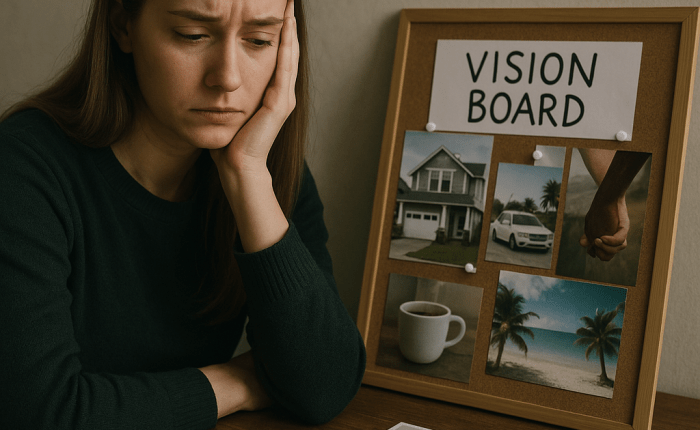
I remember once, after one of our rare calm seasons, we tried to dream again. We made a little vision board together — nothing extravagant, just things a normal couple would hope for. A peaceful home. A reliable car. A future that didn’t feel like walking through broken glass.

But his face went dark, the way it always did when anything felt too good.

He looked at me and said,

“God hates me. We will never get any of this.”

And just like that, the air changed.
The hope drained out of the room.
My body learned — again — that peace wasn’t safe, and happiness wasn’t to be trusted.

Why You Always Zero In on What Hurts

Why You Always Zero In on What Hurts

When trauma teaches you to fear the good, trusting peace can feel like betrayal

Have you ever noticed how fast your mind finds the crack in the glass?

Something good happens—and before it even settles, you’ve already ruined it in your head.
You pass the test, then tell yourself you’ll probably fail the next one.
Someone says they’re proud of you, and you immediately wonder what they really meant.
You finally get a moment of peace, and instead of resting in it, you’re holding your breath waiting for it to explode.

That’s not you being dramatic.
That’s trauma.
That’s conditioning.

When you’ve lived in survival mode long enough—when love came with punishment, when silence meant danger, when even your joy got twisted into a weapon—you stop trusting anything that feels too good.

Your brain starts treating calm like a trap.
It looks for warning signs even when there aren’t any.
Because in your experience, the good things never came without a price.

So, of course, your mind zeroes in on what hurts.
That was your safety plan. That’s how you kept yourself alive.

You learned to listen for footsteps. You studied his moods like they were gospel. You walked on eggshells because they were safer than landmines.

So when someone tells you to “just think positive” or “celebrate the good,” it doesn’t land. It feels fake. It feels dangerous. Because in your world, hope always came back with bruises.

I remember the day I reached for help.

I wasn’t even expecting a miracle—just someone to see me. I told the truth. I admitted I was scared, confused, and unraveling. I laid it all out there: how small I felt, how broken I had become, how the God I was clinging to didn’t feel like He was anywhere near me anymore.

And the answer I got?

“Just go home and be a good wife.”

No rescue. No comfort. Just a command.
That broke something in me.
I learned right then: honesty doesn’t guarantee help. Hope can backfire.
So I stopped reaching. I started bracing harder. I got quieter.
Because at least silence couldn’t slap me in the face like that again.

That moment shaped me. And not in a holy way.

But here’s what I want to tell you—what someone should have told me:

You’re not negative.
You’re not broken.
You are conditioned. And you can unlearn it.

But not by pretending. Not by slapping affirmations over your scars.

It starts small. Like this:
When the voice comes up that says, “This won’t last,” or “You don’t deserve this,”
just pause.
Don’t fight it. Don’t obey it. Just notice it.

That voice isn’t your truth.
It’s your trauma.

And slowly, you can start choosing differently.

Not because you’re suddenly healed. But because for once, you’re finally allowed to be aware of how deep the damage goes—and how much more you were made for.

You’re allowed to want peace without fear.
You’re allowed to hold joy without bracing for pain.
You’re allowed to believe something good… might actually be good.

Even if your brain’s not there yet, you are.

My People

My People

My people are positive thinkers. They believe in the good and see the good in others. They stand by me through every challenge, loving me not for what I can give but for who I am. My people lift me up, even when I feel drained from giving too much. They remind me to grow, to rise, to become the best version of myself.

When I think about my people today, I also think about where we came from—those whose blood and spirit still flow through me.

My people were Irish, transplanted to America. But for what? What freedom were they searching for? Perhaps they sought escape from the weight of strict religion—only to find themselves bound again by another form of it.

I was told we were also part Cherokee. I held onto that story with pride, feeling its truth even without proof. Maybe somewhere in my lineage, someone loved a Native soul, and their spirit found its way into mine. I feel it in the pull of the water, the whisper of the wind, the pulse of the earth beneath my feet.

I wonder what my Irish ancestors worshipped. They weren’t always Catholic or God-centered, I’m sure. I feel too much spiritual energy in my veins to believe they were ever confined to one god or doctrine. I imagine they were people of the land—forest lovers and wildflower smellers—souls who found divinity in nature itself.

Whether Irish or Native, I know my ancestors were connected to the earth, to Spirit, to something larger than themselves. Their reverence for nature runs through my blood, stronger than any written creed.

And today, my people are here with me—my children, my husband, my grandchildren—the ones who carry the same light, the same hope, the same heartbeat of all who came before us.

One Truth in Many Beliefs

One Truth in Many Beliefs

Religion comes in many shapes, colors, and languages. Each tradition uses its own words, rituals, and practices. But when I look past the surface, I see the same core ideas repeated over and over, just dressed differently. Whether it’s Christianity, Islam, Buddhism, or even the Law of Attraction, there’s a thread that runs through them all.

Ramadan, Fasting, and the Practice of Discipline

Take Ramadan, for instance. the ninth month on the Islamic calendar. Muslims fast from sunrise to sunset. No food. No water. It’s a strict discipline that resets the mind, body, and spirit.

It’s not quite like biblical fasting, where the abstention could last for days without reprieve. With Ramadan, you can eat and drink at night, which some might liken to intermittent fasting. But spiritual fasting in any form is always about more than just food. It’s about focus. Sacrifice. Clarity.

Yet there’s always a way to “beat the system” if you want to. A fast with set hours can become routine. Disciplined, yes. But also predictable. It makes me wonder, is the spirit of the practice lost when it becomes mechanical?

Same Prayers, Different Tongues

The Bible says, “Whatever you ask in prayer, believing, you will receive.”
The Law of Attraction says, “Ask. Believe. Receive.”

Different words. Same principle.

In fact, many belief systems teach that our thoughts create reality. Speak it. Think it. Envision it. And it will manifest.

The power of belief is universal.

Rituals, Symbols, and the Sacred

In Catholicism, the Eucharist is a sacred ceremony. It’s deeply symbolic: incense fills the air, holy water is sprinkled, and the priest places a piece of bread on your tongue. The lighting is dim, the setting reverent.

To an outsider, it might resemble a mystical ritual, something ancient and ceremonial, similar to what you might see in witchcraft or manifestation rites. But again, the goal is the same: connection with the divine.

One Law with Many Names

Every tradition has some version of this:
What you do comes back to you.

  • Christians call it sowing and reaping.
  • Hindus and Buddhists call it karma.
  • The secular world calls it cause and effect, or vibration.

The Golden Rule echoes it perfectly: “Do unto others as you would have them do unto you.”

It’s everywhere — spoken in every language, in every tradition.

Cleanliness, Purity, and Discipline

“Cleanliness is next to godliness.” That phrase may not be a direct quote from the Bible, but the message is biblical. Christians are warned against drunkenness. Muslims abstain from alcohol altogether. Pork is considered unclean in both Islam and the Old Testament.

There’s a shared desire across cultures to separate from what corrupts, to seek purity—whether physical, spiritual, or mental.

Giving Power a Name

Everyone thanks someone. God. Allah. Buddha. The Universe. Divine Energy.
There’s always a higher power.

But I’ve come to wonder:
What if that higher power isn’t the one we elevate above ourselves?

What if the divine… is within?

The “I Am” Within Us

In the Bible, God tells Moses: “I am that I am.”

He was declaring himself the source, the essence of all being. But he was also saying something more profound: “I am whatever you say I am.”

Think about that.

When I say,

  • “I am a mother.”
  • “I am a survivor.”
  • “I am love.”
  • “I am enough.”

I am invoking divinity. That phrase — “I am” — is sacred. It’s power. It is creation. It is identity.

The spirit lives within. The answers are within. The power is within.

Positive Thinking and the Thought-Life Connection

Philippians tells us to think on things that are true, noble, lovely, and good.
Positive thinking teaches us to avoid toxic thoughts because they affect our lives.
It’s the same idea. Again.

The power of thought. The power of words. This is a universal law — not owned by one religion, but revealed in all of them.

Does Every Religion Have a Devil?

In Christianity, Satan plays a prominent role as the deceiver, the accuser. But I find myself asking: Do other religions have a “devil”?

Do Muslims have a Satan?
Does Buddhism have a devil figure?
Or is this idea of a singular dark enemy unique to Christianity?

That’s a question worth digging into.

Sometimes I think Christians give Satan too much credit. They attribute every hardship to him, giving him more power than he deserves. Maybe that’s precisely what he wants.

But perhaps the real enemy isn’t external at all.
Maybe it’s internal, fear, ego, anger, or doubt.

Even Atheism Holds a Place for God

Even an atheist, by declaring “There is no God,” acknowledges the idea of God.
They define their position in relation to Him.
It’s been said that there are no atheists on their deathbed. Maybe that’s true. Maybe not. But the instinct to reach for something beyond this life seems built into us.

Omnism: The Path of Many Roads

There’s a belief called Omnism — the idea that all religions hold some truth, that each one offers a piece of the divine puzzle.

They’re not all about clothes or dietary laws. They’re about how we think, how we act, and how we love.

Because love is another universal.
Love never fails. Love endures all things. Love makes the world go round.

Final Thoughts: The Universal “I Am”

In the end, I believe this:
There is one Spirit. One Energy. One Truth.
Many names. Many faces. Many paths.
But at the center of it all is the divine I Am.” The one that lives within you and me.

You are the vessel.
You are the voice.
You are the I Am.

Question Everything

Question Everything

“Learn from yesterday, live for today, hope for tomorrow.  The important thing is not to stop questioning.” – Albert Einstein

Have you ever asked God, “Why?”

Have you ever questioned His existence?

Have you ever screamed out in agony, wondering why YOU even exist?

Have you ever wondered how a “loving God” could allow such pain and suffering?

Have you ever sat in a puddle of your own tears and felt you couldn’t go on?

Have you ever felt the hatred burning in your bones?

Have you ever tried to wake up, hoping it was just a nightmare?

Have you ever sought answers but found none?

Have you ever wondered, “Why me?”

Have you ever put on a fake smile so that you didn’t have to talk about it?

Have you ever wanted to start all over?

Have you ever wanted to give up? Everyday?

Have you ever wondered why you couldn’t get on the good side of life?

Have you ever felt cursed?

Have you ever felt depressed and regretted so much of your life?

I have.

“The power to question is the basis of all human progress.” – Indira Gandhi

How many times have you been told that you should never question God? I lost count of the times I was told that.  But guess what? He understands.  We were born questioning everything around us.  That is how we learn and grow.  The only ignorant question is the one that is never asked.  Asking questions clears confusion, gives us a better understanding of any given situation, and helps us find answers.  Questions help solve problems.  It is absolutely fine to question our life; it shows that we do not accept our current position or status and that we are willing to improve.

One Secret I Still Keep Is…

One Secret I Still Keep Is…

What You’d Never Guess Just by Looking

Does it have to be just one? There are a few secrets I keep.

The first thing that comes to mind is that I gave birth to 11 children. One at a time. However, that’s no longer really a secret. It is information I usually do not tell people. Not because it is such a big secret, but because their brains cannot seem to comprehend how one woman gave birth to that many children. Or why. Now that is the true secret.

Why? Why did I have that many kids?

Well, first and foremost, because we were in a religious mindset that allowed God to choose how many children we have. But I will tell you that when I was 40 and pregnant, I chose for myself to get that fertile tube tied up, or cut off, or whatever they do, so I cannot get pregnant again. (I only had one tube and ovary by the time 11 came around.) Another reason I had 11 children was that, with the birth of each new baby, came another person/soul who would love me unconditionally and make my fractured life feel whole, even if only temporarily. I desperately longed for someone to love me. And when a baby looks up at you and smiles because you are their entire world, you get the feeling.

Love. The missing piece of me.

Maybe it sounds selfish, but I wanted someone to need me the way I had needed others who didn’t show up.


Another secret I  keep is about my oldest son being in prison. He was a highly respected individual. Everyone loved him. So, for the longest time, whenever anyone asked me where he was or how he was doing, I would answer, “I don’t want to talk about it.” But the bigger secret in that is why he is in prison.

Why?

Because he was so traumatized as a child that he sexually traumatized a child, that’s why. It’s not an excuse, just a truth I’ve had to live with. Pain that isn’t healed will try to find something — or someone — to break.


A third secret I don’t tell anyone: I was a pastor’s wife for 20 years. I never really asked myself why I was, so the “why” in this situation is: why do I keep it a secret? Good question, good soul search here.

Why?

Because I do not want anyone to ask me what I believe now, I am still trying to figure all that out. Like, do I still want to use the term “God,” or is it the Universe, or is it just Spirit? None of those feels right. The closest to feeling like my truth is Universal God or Universal Spirit. But like I said, I am still working that out. I keep it a secret because I do not want people trying to persuade me back into church, back into conformity. I do not want to go to church every Sunday and Wednesday. I don’t want to go door-knocking, soul-witnessing, or whatever they call it. I cannot sit in a service without being overcome with anxiety. My nervous system shuts down, and I usually fall asleep. But I sit there and feel like a ghost of myself, singing words that no longer have a place to land inside me. I know this because I have tried. I tried to find a church so my youngest son could get a taste of religion and decide for himself whether it is something he wants. It’s a secret because I probably disagree with 90% of what they might be talking about if you tried to strike a spiritual conversation. I have read the Bible cover to cover multiple times. There is nothing they can say that will get me to see things differently. It’s a secret because I have not yet dared to share my beliefs with the world.

But here’s a start.

I believe God was female in nature. I believe the Bible is a history book. I think every religion has its great “man of the hour.” The Christians had Jesus. The Muslims have Mohammad. The Jews have the Messiah, and so on. I believe it’s the same thing, just described in a different style. Reaping what you sow is the same thing as karma. The Ten Commandments do not differ much from the Delphic maxims. Maybe the real secret isn’t what I’ve kept — it’s how long I’ve waited to say it out loud.


And the last secret I keep is my age.

They say you’re only as old as you feel. Some days I think I’m 37. Other days I feel 57. It changes with the weather, the weight of the day, or the way my knees sound when I stand up too fast. People often tell me I look so young — thankfully. And I want to keep it that way. Because age isn’t just a number, it’s a perception. It’s the difference between someone listening to your story and brushing it off. So I let them guess. And I let myself believe it too, some days.

The Book That Changed Everything

How grace broke the chains of control in my home and heart

“We are responsible to each other, not for each other.”
— Jeff VanVonderen, Families Where Grace Is in Place

I don’t remember the exact year or even where we were living at the time. But I know it was somewhere between 2007 and 2009 when I picked up a book that would change everything: Families Where Grace Is in Place by Jeff VanVonderen.

I didn’t know it then, but those pages were about to unravel everything I thought I believed about parenting, marriage, and faith.


Before Grace

At the time, I was a stay-at-home wife and a homeschooling mom of ten. Number eleven would arrive later. I was also a preacher’s wife. My husband and I were fully immersed in Independent Fundamental Baptist ministry. We pastored churches, traveled as evangelists, and held revival meetings across the country.

We were loyal. Passionate. Zealous. And convinced we were right.

We preached that having a television was sinful. That women wearing pants was sinful. That too much makeup was sinful—though a little was allowed, so long as it didn’t “draw attention.” I sewed all my own dresses and wore my hair long—though thanks to my hormones, it rarely got far past my shoulders.

We were strict with our children. They had no phones, no TV (because we didn’t own one), no outside friends, no sports. We believed all of those things would lead to sin. We even pulled our oldest son out of college once, convinced he was living “outside the umbrella” of parental authority.

We spanked often. Sometimes for small things. Sometimes for nothing more than an attitude. Every day, we sat our kids down and taught them right from wrong. We drilled obedience into them—not from a place of love, but fear. Fear that if they messed up, it would reflect badly on us. That we’d look like failures. That God would be disappointed.

When we lived in Iowa, I made my girls wear skirts over their snowsuits just to play outside. When we went swimming, it was always in remote places. The girls swam in culottes. The boys wore jeans. My children weren’t allowed to have their own opinions or make their own decisions.

They were born walking on eggshells—and we made sure those eggshells never cracked.


The Book

I don’t recall how I ended up with Families Where Grace Is in Place. Maybe someone passed it to me. Perhaps I picked it up on a whim. But as I began reading, the words leaped off the page. Sentence after sentence felt like someone had opened a window I didn’t even know was there.

The book talked about how families fall into cycles of control, pressure, and manipulation—often in the name of love or righteousness. It spoke of the deep weariness that comes from trying to meet impossible standards. The perfectionism. The fear of failure.

That was us. Especially with so many children, we constantly felt watched, judged, and evaluated. Our theology was built on performance. And we were exhausted.

Then came a line that hit me in the chest:

“We are responsible to each other, not for each other.”

It undid me. All at once, I saw the truth. I wasn’t parenting out of love—I was parenting out of fear. I wasn’t guiding my husband—I was trying to control him. And he was trying to control me. Together, we had built a family that looked good on the outside but was suffocating on the inside.

The book painted a different vision: one where grace replaced fear. Where children were free to make decisions and mistakes. Where love didn’t mean control. Where acceptance was not conditional on perfection.

And something inside me shifted.


The Bridge

As I read, I had one aha moment after another.

I realized we were trying so hard to protect our children from the world that we were crushing their spirits. We didn’t want them to sin, so we removed their freedom. We didn’t want them to mess up—so we made every decision for them. We called it holiness. But really, it was fear.

Even our decision to homeschool wasn’t about education. It was about control. About keeping their behavior within a bubbl,e we could manage.

After trying to “homeschool with grace” for a while, I finally admitted the truth: we weren’t equipped. So we enrolled our children in public school.

It wasn’t a seamless transition. One of my daughters started school in her junior year and had to double up on math to catch up. Thankfully, Arkansas accepted her science, history, and English credits. One of my younger girls had to repeat kindergarten because I hadn’t finished the year—we had opened a daycare in our home, and it consumed my time and attention.

My third daughter and fifth son—only a year and a half apart—both entered fourth grade the same year. He had fallen behind under my teaching. I warned the principal to separate them; I knew she’d do all his work if they stayed together. They listened, and the school helped bring him up to speed within that year.

During this season of change, I was also starting to rediscover my own worth. I filed for a restraining order against my abusive husband. For a time, I let him come back—still caught in that old belief that if I just tried harder, he would change. That if I prayed more, obeyed more, submitted more, he would become the man I needed.

But I was beginning to see: you can’t change someone by controlling them. You can’t fix someone who doesn’t want to be fixed.


After Grace

It’s been over 16 years since I read that book. My baby is now a junior in high school. The way I parent him is entirely different than how I raised the others—especially the oldest ones.

I’ve apologized to some of my children. I’ve told them I wish I could go back and do it all differently. And I mean it. I see some of them now, parenting the way I once did—out of fear, trying to control everything. But I don’t lecture. I offer gentle reminders. I try to model something different.

Our family structure isn’t perfect. Our children aren’t perfect. I’m not perfect. One of my sons is in prison. That hurts to say. But even in that, grace remains. We no longer try to control each other. We don’t panic when we see a child or sibling making choices we wouldn’t make. We offer love. We offer space.

And we let go.

Letting go is hard. Watching someone you love repeat mistakes you’ve already made is hard. Trusting grace instead of fear is hard.

But control?

Control is harder.


💬 Want to share your story of breaking free from control-based parenting or faith structures? Comment below or message me privately — you’re not alone.