Cell Phones

What technology would you be better off without, why?

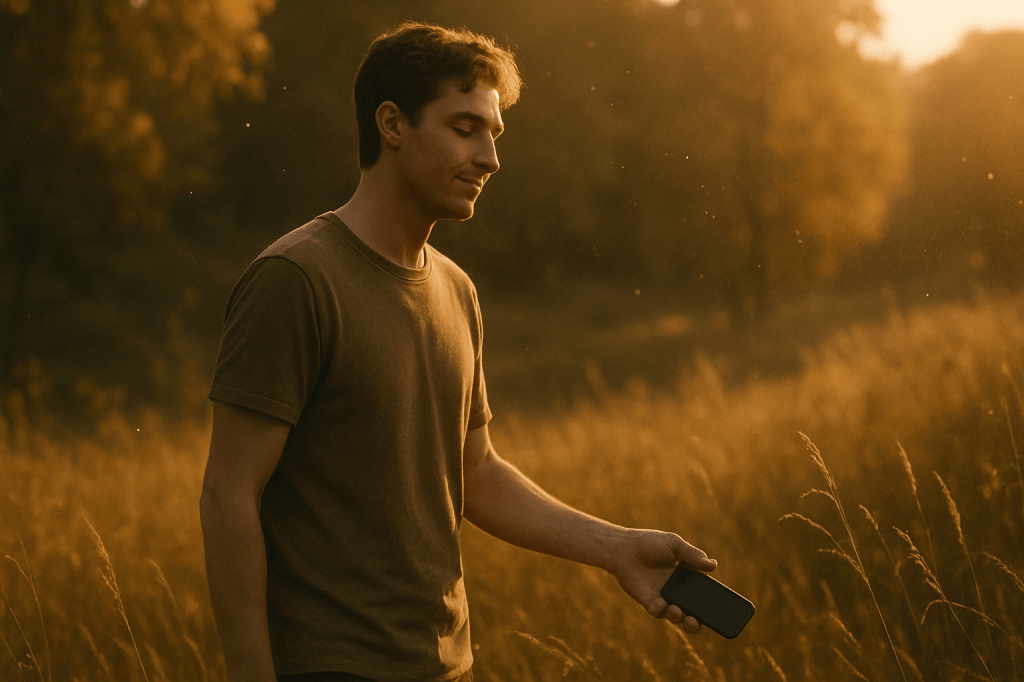
The little rectangles that own us
more than we’d ever admit.
We cling to them like lifelines,
but they drain more than they give.

Take them away
and maybe people would finally remember
what boundaries are.
No more entitlement to instant replies,
no more “?” as a guilt trip,
no more being punished
for daring to exist offline.

Life wouldn’t get twisted
into misread texts and passive-aggressive punctuation.
We’d have to speak.
Out loud, with real voices.
Exposing those hiding behind screens.
Transparency terrifying them, because they might really be seen.

And let’s not ignore the anxiety tax:
We’re fed a constant drip of news
we were never meant to carry.
Tragedies across the globe
delivered before breakfast,
opinions we didn’t ask for,
chaos we can’t fix.
Without a cell phone,
half the things we stress over
wouldn’t even reach us.

We might actually look up, too.
Notice the world
With its brutality and its beauty.
Its everything we scroll past
because we’re too addicted
to the glowing distraction.

And the money we pour into these things…
the pointless upgrades,
the cases, the cables,
the repairs, and replacements.
All for a piece of tech
that clearly stresses us out.

Take away the cell phone
and life wouldn’t be as harsh.
It would be quieter,
more spacious,
more ours.
Less noise, less pressure,
less manufactured urgency.
More peace in the places
we forgot peace could exist.

We might finally notice
our own thoughts again.
Hear the world around us
instead of the notifications.
And live instead of react.
DON’T TAKE IT PERSONAL

DON’T TAKE IT PERSONAL

Why You Take Everything Personally (And What No One Told You About It)

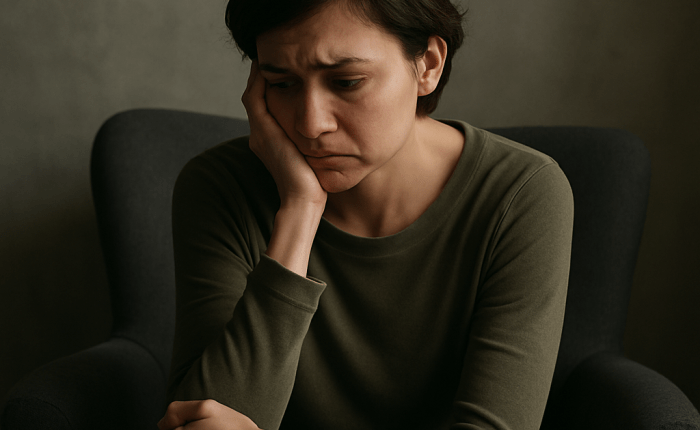
Let’s be real. You don’t just “hear” what someone says—you absorb it.
A sigh? You feel it like a slap.
A short text? Your stomach drops.
If they are quiet? You spiral.

Taking things personally isn’t a flaw—it’s a reaction to what you’ve been through…

Someone trained you to feel this way.

Maybe you were in a relationship like mine—one where your partner, or parents, made sure you were never really safe. Where you had to study their mood the way a sailor studies the sky.
Because one wrong word, one wrong look, could start a storm.

I know what that feels like.
To live in a home that felt more like a test.
To love someone who used your love against you.
To be blamed for everything—their anger, their silence, their outbursts, their boredom.

When you’re with an abuser, especially for years, you don’t just fear them—you become them in your own head.
You start criticizing yourself before they can.
You start shrinking your needs because it’s safer that way.
You start interpreting everything around you as a threat.

That’s why you take things personally.
Because you were trained to see danger in the subtlest shifts.

You were taught that mistakes mean punishment.
That emotions are weapons.
That love means walking on eggshells while setting yourself on fire to keep someone else warm.

So now, when someone gives you feedback, you feel attacked.
When someone pulls away, you assume it’s your fault.
When someone’s upset, you blame yourself.

But here’s the part you need to hear:
It’s not your fault.

You were conditioned to believe that your survival depended on reading people perfectly.
You weren’t being sensitive—you were being smart.
You were protecting yourself.
But now?
Now you don’t have to live like that anymore.

That voice in your head telling you “you messed up,” “they hate you,” “you ruined everything”—
That’s not your voice.
That’s theirs.
That’s the voice of the person who broke you down, not the one who gets to build you back up.

And you’re allowed to question it.
You’re allowed to replace it.
You’re allowed to heal—even if they never apologize.

So if you’re sitting there wondering why you take things so personally, let me say this:

You’re not crazy.
You’re not broken.
You’re carrying a survival instinct that once kept you safe—but it doesn’t have to run your life anymore.

You can learn to breathe again.
To trust again.
To love without fear.
To hear someone’s words without turning them into wounds.

You’re allowed to take your power back.

One truth at a time.

Why Happiness Makes You Nervous

Why Happiness Makes You Nervous

For the girl who thinks the tightness in her chest is normal

Good times make you nervous, don’t they?

You don’t call it fear—you call it “being cautious,” or “not getting your hopes up.” But the truth is quieter: you’re not used to peace. For so long, love has felt like tension, panic, apologizing, overthinking, and walking around someone else’s moods like they’re landmines.

So when something finally goes right… Your whole body glitches.

You look around, waiting for the explosion.
You wait for the tone in his voice to shift.
You wait for the moment he decides you’re “too sensitive,” “too emotional,” or “too much.”

And if nothing happens right away, your brain fills the silence with dread: Is this the part where it all turns again?
You don’t trust happiness—not because you’re broken, but because you’ve survived too long without it.

Girls like us learn early that peace feels like a trap.
A setup.
A calm before the next storm.

No one told you that real love isn’t supposed to feel like bracing for impact.
No one told you that safety isn’t the same thing as “keeping the peace.”
No one told you that if your body relaxes only when he isn’t home… that’s not comfort. That’s survival.

Listen, sweetheart—if happiness feels foreign, it’s not because you’re incapable of it.
It’s because someone taught you to expect pain.

And here’s the part I wish someone had whispered to me sooner:
You don’t have to keep living in the story where fear feels like love. You don’t have to keep shrinking yourself just to fit into a relationship that was never safe to begin with.

Real peace doesn’t make you nervous.
Real love doesn’t make you flinch.
And real happiness doesn’t feel like a setup—it feels like finally coming home to yourself.

You deserve that kind of happiness.
And I promise… it won’t explode.

When someone ties despair to God Himself, it buries you in a deeper kind of fear. You stop dreaming. You stop believing in the better. And every time life gets quiet, you brace yourself, because you know the calm never lasts.

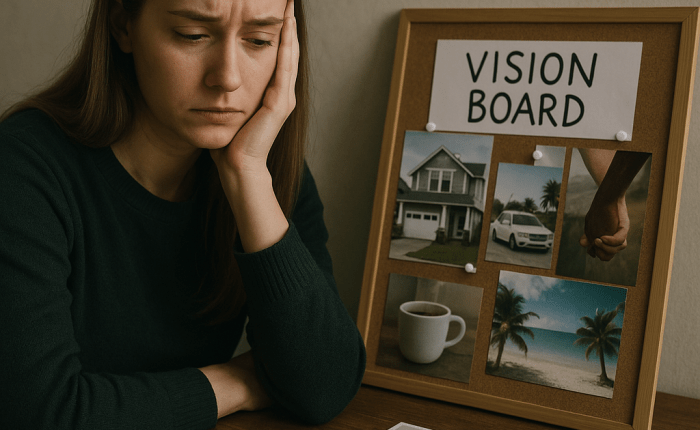
I remember once, after one of our rare calm seasons, we tried to dream again. We made a little vision board together — nothing extravagant, just things a normal couple would hope for. A peaceful home. A reliable car. A future that didn’t feel like walking through broken glass.

But his face went dark, the way it always did when anything felt too good.

He looked at me and said,

“God hates me. We will never get any of this.”

And just like that, the air changed.
The hope drained out of the room.
My body learned — again — that peace wasn’t safe, and happiness wasn’t to be trusted.

When You Take the Blame That Wasn’t Yours to Begin With

When You Take the Blame That Wasn’t Yours to Begin With

To Every Woman Still Carrying the Weight That Was Never Hers

I used to believe that everything was my fault.

The slammed doors, the silence, the yelling that followed the silence, the fists that followed the yelling—I took the blame for all of it. If dinner was cold, it was my fault. If he had a bad day, somehow I caused it. If he lost his temper, I should’ve known better. I should’ve stayed quiet. I should’ve smiled more. I should’ve been less.

When you live under the same roof as someone who thrives off control, you learn quickly that survival means shrinking yourself. It means bending until you barely resemble a person. It means learning the art of swallowing blame for things that never had anything to do with you—because arguing only brings pain, and agreeing brings temporary peace.

But what they don’t tell you is that even when you get out—when you finally pack the bags, find the courage, or flee in the middle of the night with nothing but your breath in your chest—that voice follows you.

Even in freedom, I found myself taking the blame for things that weren’t mine.

If a friend was upset, I’d replay our last ten conversations, convinced I did something wrong. If my boss looked stressed, I’d take on extra work, hoping it would ease a tension I didn’t cause. I’d apologize for everything. For asking questions. For not asking enough. For existing, sometimes. I was hunting for ways to feel terrible, and life kept handing me proof that I was right… because that’s what trauma does. It warps the lens.

But here’s the truth I’ve learned—he was wrong.

I was not the problem. I was not too sensitive. I was not too loud or too quiet or too emotional or too needy. I was not weak for staying. I was not selfish for leaving.

Healing isn’t linear, and it sure as hell isn’t clean. Some days, the guilt creeps back in like fog through a cracked window. But I catch it now. I see it for what it is: a ghost of the past, trying to convince me that I’m still that powerless woman I used to be.

I’m not her anymore.

I don’t carry blame that isn’t mine. I lay it down and walk away from it.

Now, I advocate. I speak. I write. I sit with other survivors and tell them: you are not crazy. You are not broken. And you are not to blame.

If you’re reading this and you’ve ever felt like the villain in your own story—take a breath. Hand back what was never yours to carry.

You deserve peace. You deserve love. And most of all, you deserve to be free from blame that was never yours to begin with.

You survived.

Now it’s time to thrive.

The Victim Mindset Is Keeping You Stuck

The Victim Mindset Is Keeping You Stuck

Why Blaming the Past Feels Safe—but Is Silently Sabotaging Your Growth

There’s a mindset that keeps people trapped—and often, they don’t even realize they’re in it. It shows up subtly, quietly, in the way someone reacts to life’s hardships. And over time, it becomes the lens through which everything is seen.

It’s the victim mindset.

It convinces you that life is just happening to you. That your circumstances, your past, and the way people have failed you are the reasons you can’t move forward. And while there may be truth in those hardships, staying stuck in that story only leads to one place: nowhere.

This mindset is especially dangerous because it feels justified. You’ve been hurt. Life has been unfair. Opportunities have slipped through your fingers. But the victim mindset doesn’t just acknowledge the pain—it builds a home in it. It keeps you focused on what’s been done to you rather than on what you can do now.

And the most painful part? Sometimes, it makes you push away the very help that could make a difference.

You might tell yourself that you’re independent—that you’ll figure it out alone. But if you’re rejecting real, practical help while still depending on handouts or the temporary kindness of others, that’s not strength. That’s survival. And survival is exhausting when there’s no plan to move beyond it.

When you stop asking yourself hard questions like, “What part am I playing in this?” or “What can I take responsibility for?”, you give your power away. It’s easier to blame the system, your past, or your circumstances. But blaming keeps you stuck. It keeps you from healing. And it lets you off the hook.

The truth is: you’re not powerless. You’re not broken. And you’re not doomed.

But if you’re constantly rejecting growth, avoiding discomfort, and refusing to let others help you in meaningful ways, you’re choosing stagnation. And deep down, you probably know it.

Real change is hard. Accepting help feels vulnerable. Facing your patterns takes courage. But that’s where transformation lives. It’s not in the blaming, the begging, or the surviving—it’s in the choosing.

You can’t heal what you refuse to take ownership of.
You can’t rise if you keep convincing yourself that you’re stuck.
And you can’t move forward if you keep turning your back on the help that’s already within reach.

Let this be the moment you get honest with yourself. Not to shame or guilt yourself—but to reclaim your power.

Because the victim mindset will always keep you stuck —and you deserve better than that.

I see this in my daughter. We have sent her to trade school twice, but she has dropped out both times. We paid off her car, paid her auto insurance for a year, and helped her pay for her own apartment.

And now she is in a worse place than before we did that, begging people for money.

My family members and I offer true, lasting help – like coming to stay with us so you can get on your feet, etc. – but she refuses. Instead, she chooses to remain in the chaos, her comfort zone.

Why You Always Zero In on What Hurts

Why You Always Zero In on What Hurts

When trauma teaches you to fear the good, trusting peace can feel like betrayal

Have you ever noticed how fast your mind finds the crack in the glass?

Something good happens—and before it even settles, you’ve already ruined it in your head.
You pass the test, then tell yourself you’ll probably fail the next one.
Someone says they’re proud of you, and you immediately wonder what they really meant.
You finally get a moment of peace, and instead of resting in it, you’re holding your breath waiting for it to explode.

That’s not you being dramatic.
That’s trauma.
That’s conditioning.

When you’ve lived in survival mode long enough—when love came with punishment, when silence meant danger, when even your joy got twisted into a weapon—you stop trusting anything that feels too good.

Your brain starts treating calm like a trap.
It looks for warning signs even when there aren’t any.
Because in your experience, the good things never came without a price.

So, of course, your mind zeroes in on what hurts.
That was your safety plan. That’s how you kept yourself alive.

You learned to listen for footsteps. You studied his moods like they were gospel. You walked on eggshells because they were safer than landmines.

So when someone tells you to “just think positive” or “celebrate the good,” it doesn’t land. It feels fake. It feels dangerous. Because in your world, hope always came back with bruises.

I remember the day I reached for help.

I wasn’t even expecting a miracle—just someone to see me. I told the truth. I admitted I was scared, confused, and unraveling. I laid it all out there: how small I felt, how broken I had become, how the God I was clinging to didn’t feel like He was anywhere near me anymore.

And the answer I got?

“Just go home and be a good wife.”

No rescue. No comfort. Just a command.
That broke something in me.
I learned right then: honesty doesn’t guarantee help. Hope can backfire.
So I stopped reaching. I started bracing harder. I got quieter.
Because at least silence couldn’t slap me in the face like that again.

That moment shaped me. And not in a holy way.

But here’s what I want to tell you—what someone should have told me:

You’re not negative.
You’re not broken.
You are conditioned. And you can unlearn it.

But not by pretending. Not by slapping affirmations over your scars.

It starts small. Like this:
When the voice comes up that says, “This won’t last,” or “You don’t deserve this,”
just pause.
Don’t fight it. Don’t obey it. Just notice it.

That voice isn’t your truth.
It’s your trauma.

And slowly, you can start choosing differently.

Not because you’re suddenly healed. But because for once, you’re finally allowed to be aware of how deep the damage goes—and how much more you were made for.

You’re allowed to want peace without fear.
You’re allowed to hold joy without bracing for pain.
You’re allowed to believe something good… might actually be good.

Even if your brain’s not there yet, you are.

Before the World Awakes

Before the World Awakes

Even the most ordinary mornings are full of movement, memory, and quiet decisions.
Maybe we don’t need big moments to feel present—just enough space to notice the small ones.

I turned over in bed, wondering how long I’d been in that same position. My arm had fallen asleep, and my chest felt crunched. I took a deep breath, thinking about checking the clock, but I also wanted to roll back over. I usually toss and turn all night, but this time, I didn’t. Must be the progesterone doing its job.

I adjusted my pillows — only to realize one was missing. I patted around until I found it above my head. Did I slide down during the night? Did I fall asleep on my husband again? That usually throws off the pillow setup. I sat up, got the pillow back under my head… and then, of course, my alarm started to vibrate, lighting up the room.

Oh no — it’s going to wake him. I never let the alarm go off. I’m usually up before it. I tapped the dismiss button on my watch and sat on the edge of the bed, brushing hair out of my face — except it was stuck. Strands crisscrossed my mouth, nose, and eyes. What in the world? Did I drool? Then I remembered — my detox box sent me that nighttime serum that makes my face sticky. That explains it.

I grabbed my phone, picked up my clothes from the floor — we both agreed sleeping naked is non-negotiable — and tiptoed to the bathroom. I used my phone light to close the door slowly. The bathroom light stays off — his eyelids are basically transparent. He’s a night owl. I’m a morning person. Our compromise is to be in bed by 9–10, and I’m up between 3 and 4. He “sleeps in” until 6:30.

I turned on the closet light instead — it’s in the bathroom, which I always thought was a weird design choice, but it works and is quite convenient. I sat on the toilet, like usual, giving my body time to eliminate any bad decisions from dinner. Then I changed into yoga pants, a sports bra, and one of my many sweatshirts. I always tell myself I need to buy another one—I wear them year-round.

Then came the stealth mission: turn off lights, tiptoe across the tile (hoping my ankles don’t click), and open the bedroom door without setting off the vacuum-force door slam. The cat meowed her usual greeting — so I didn’t wake him, but I did wake her. Last obstacle: close the door behind me with just the right amount of pressure to keep the vacuum from yanking it.

Once it clicked into place, I exhaled. I hadn’t even realized I was holding my breath.

The kitchen was dark. I turned on the light and went through the usual motions:
Tea pod out. Decaf in. Brew on espresso.
Creamer in the frother. Start.
Swap in a chicory pod. 10oz of bold flavor.
Yeti from the dishwasher. Cream, coffee, done.
Spring water in a glass. Cat fed.

And now I’m downstairs, writing this, wondering…

  • Is it out of respect for his sleep… or is there something comforting in the ritual of moving unnoticed?
  • Is it desire for peace, control, or maybe even to feel needed in the stillness?
  • Why do small creatures always seem to keep us on schedule better than alarms?
  • Does waking early give me a head start… or just a moment to exist without anyone else’s noise?
  • And what am I really trying to let go of — each morning, sitting there in silence, waiting?

When Pain Feels Familiar, And Peace Feels Like ARisk

When Pain Feels Familiar, And Peace Feels Like ARisk

It’s not your fault you feel this way. But you don’t have to stay there.

Sometimes it feels like emotions happen to us, like the weather.
“I guess I’m just sad today.”
“It is what it is.”

But here’s the part no one tells you:

You might not get to choose the feeling that shows up. But you do have a say in how long it stays there.

When we’ve been through trauma or long-term hurt, sadness, or pain can start to feel familiar. It’s almost comforting in a strange way. We stop trying to feel better because part of us doesn’t trust that “feeling better” is even possible. So we sit in the sadness like it’s the only place we belong.

Sometimes, without realizing it, we even let the pain in like a guest who shows up uninvited…. and we don’t ask it to leave. Not because we want to suffer, but because suffering is what we know. It feels predictable. Safe. Normal.

But here’s the truth:

You’re allowed to feel your feelings, and you’re allowed to move through them.

Pain doesn’t have to be your home anymore. You deserve moments of peace, even if they feel unfamiliar at first, because you deserve better.

It took me over 20 years to realize that I deserved better. I sat in my pain day after day—wishing it would go away, wanting it to stop—but doing nothing about it because it had become my comfort zone. I was stuck in a rut and had no idea how to pull myself out.

But once I finally recognized that I did deserve better, the answers started coming to me — sometimes slowly, and sometimes all at once.

I spent 24 years in an abusive marriage. Today, I can say I made it out. And so can you.

It’s My Birthday

It’s My Birthday

After 50, birthdays are not as welcome or eagerly anticipated.
Maybe because they no longer symbolize beginning—they feel more like markers of what’s already passed.

I’m in the era of searching for the fountain of youth.
Not in fairy tales or myths—just in small hopes, routines, supplements, & habits.

I want to live to be 100, but sometimes my body tells me it’s not so sure it will.
And on those days, it feels like I’m negotiating with time.

50 is the halfway point, and 57 is past the halfway point.
It depends on the lens: optimism or realism. I’ve already stepped beyond that imagined middle.

I’m still quite a way from 100, but as the years go by faster and faster with each birthday, it doesn’t feel like it’s only 43 years away.
Time feels slippery now, like it’s speeding up while I’m slowing down.

And see that little word “only” — 43 is less than 50, and 43 is too soon.
It used to sound like a lifetime. Now it sounds like a countdown.

They say to live every life like it is your last, and live each day like it is your last.
A noble idea. But who can actually do that, every day?

I definitely couldn’t do all the things I’ve wanted to do in life in 1 day.
I couldn’t fit it into this one day.
Dreams take decades. Some never arrive. Some arrive too late.

But I could treat people and anyone I came across as I would if today were “it.”
I could. I can be the best version of myself TODAY.
And maybe that’s more powerful than any bucket list.

Why No One Can Cheer You Up (And Why You Don’t Want Them To)

Why No One Can Cheer You Up (And Why You Don’t Want Them To)

It’s not that you can’t feel better…it’s that you don’t trust better.

When you’re upset, it feels like nothing can touch you. Friends try to cheer you up, but their words bounce right off. You shut it down with,

“You don’t understand,” or “I can’t help the way I feel.”

Here’s the thing: you’re not wrong for wanting to sit in your feelings. Pain can feel safer than pretending everything’s okay. But sometimes, without realizing it, you hold on to that pain like proof. Proof that you were hurt, evidence that your feelings are real, proof that you’re not invisible.

And letting it go? That feels scary. Because misery, as heavy as it is, can start to feel familiar. Almost like home.

You’re not broken for feeling this way. You’ve just learned to live with despair for so long that happiness feels foreign. But here’s the truth: you deserve more than the familiar depression. You deserve peace, even if it feels uncomfortable at first.

Such was I. I lived in an abusive marriage for 24 years. When I finally dared to leave, I started reflecting and asked myself,

“Why had I stayed so long?”

In the future, I knew I didn’t want to make the same mistake. I didn’t want to end up in another abusive marriage. So I looked back at my past relationships, and they were all the same. Abusive.

Wow. Who am I? And why am I choosing this path?

That’s when I realized I had an addiction problem. I was addicted to pain—the pain and the drama of the chaos. I was stuck in a cycle, like a revolving door. So I constantly had to remind myself why I was leaving. I had to remind myself that I deserved better and that I should look for someone who was the complete opposite.

And that’s precisely what I did. Today, I stand on the other side of abuse. Stronger, freer, and committed to helping others find their own path out.

Need help?
If you or someone you know is struggling with addiction, emotional distress, or abuse, support is available 24/7:

  • Addiction Recovery: Call 866-606-0182 or visit our treatment center directory
  • Suicide & Crisis Lifeline: Dial 988 (free, confidential, 24/7)
  • Domestic Violence Hotline: Call 800-799-7233 or text START to 88788
  • Sexual Assault Hotline (RAINN): Call 800-656-4673 or visit online.rainn.org

You are not alone. There is help. There is hope. And you are worth the healing.