When Doing the Right Thing Still Makes You Feel Like the Villain

When Doing the Right Thing Still Makes You Feel Like the Villain

A story about family, guilt, and the cost of choosing someone’s peace and safety

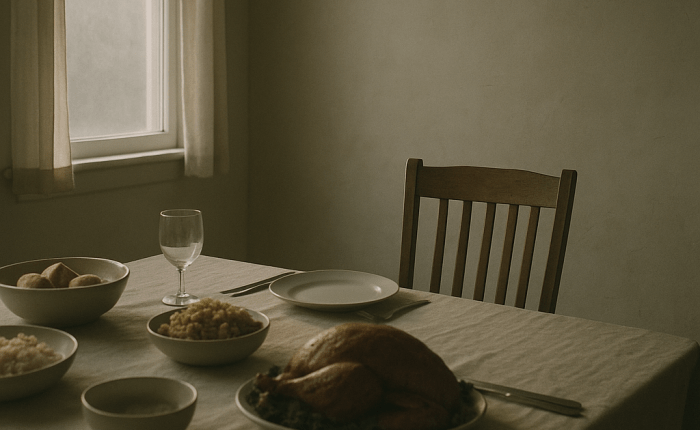
This year, I set a boundary with my parents.

We didn’t go to their house for Thanksgiving. We had it at ours instead. That might sound small to someone outside the situation, but it wasn’t. It carried years of pain, silence, and choices that should never have been mine to carry.

It wasn’t even about me this time. It was about my daughter.

There’s a story I’m not going into here, but I’ll say this much. My daughter was violated by a family member, their grandson, my son. He’s in prison now for what he did to her. But my parents still choose to stay in contact with him.

She was the one who said she didn’t want to go. She didn’t want to sit in a place that still protects the person who hurt her. And I decided to support her, choose her, and stand on her side.

It was the right thing. I know that. But it didn’t stop the fallout.

My mom didn’t speak to me for a whole week. My dad turned on the guilt, the blame, and the disappointment. Like I was the one punishing them. All I did was protect my daughter from the people who made her feel betrayed.

And still, I spiraled. I second-guessed myself. I wondered if I was being dramatic, if I had taken it too far, if I was being cruel by drawing a line.

That’s how deep the conditioning goes. That’s how beating yourself up becomes your favorite hobby.

You protect your child. You do what you know is right. And then you punish yourself for it.

Here’s how that cycle works. Here’s how the guilt gets under your skin and stays there, even when it shouldn’t.

1. You confuse guilt with being good.
You grew up thinking that if it hurts, it must mean you care. If you carry the guilt long enough, maybe it proves you’re the better person. Perhaps it means you’re nothing like the ones who hurt you. So you hold it. You nurse it. You call it empathy, but it’s not. It’s grief. It’s fear. It’s survival mode, you never got the chance to grow out of.

2. You turn on yourself before anyone else can.
It’s safer that way. You blame yourself first. You get ahead of the punishment. You run the worst-case scenario before it even happens. That way, if someone does get mad, you’re already halfway into self-destruction. You don’t have to be blindsided. You’re already bleeding. You call it control, but it’s fear disguised as preparation.

3. You were trained to carry the weight for everyone.
Keeping the peace was your job. Making things easier and smoothing things over. So when you finally make a decision that protects someone else, someone innocent, someone hurt, it still feels like betrayal. It feels like you’re letting everyone down, even when you’re the only one standing up for what’s right.

4. You think beating yourself up makes you accountable.
You think that if you suffer enough, it proves you’re not careless. That you’re not cold. That you understand the impact. But accountability is not self-punishment. It’s not turning your own heart into a punching bag. Accountability means standing in your truth and owning your choices, even when they hurt, even when you’re alone in them.

You can know something is right and still feel crushed by the guilt of doing it. That’s the part people don’t talk about.

The pain of healing is that it often makes you look like the villain to the people who benefited from your silence. And the reflex to beat yourself up is strong. It feels like the only way to keep the peace with yourself when everyone else is pulling away. But beating yourself up is not the same as being good. It’s just the story they taught you to believe. And you don’t have to keep telling it.
How to Recover After Someone Humiliates You

How to Recover After Someone Humiliates You

If something happened that left you shaky, ashamed, exposed, or suddenly doubting yourself, I want you to know this:

What you’re feeling is real. And it makes sense.

Most people have no idea what humiliation actually does to a person. They think it’s “just embarrassment.” They think you should shrug it off. But humiliation is a psychological wound. It hits the same part of your brain that reacts to physical pain. It knocks your confidence, your voice, and sometimes your sense of self out from under you.

And if no one ever taught you how to deal with this kind of emotional blow, you might be blaming yourself for a wound you never deserved.

Let’s walk through this slowly, in a way that makes space for your pain and gives you a way forward.


1. Something painful happened — you didn’t imagine it

Someone cut you down.
Someone used their words, tone, or power to make you feel small.
Someone spoke to you in a way that pierced straight through your dignity.

You weren’t “overreacting.”
You weren’t “too sensitive.”

You were caught off guard by a moment that should not have happened.

Humiliation exposes the person who delivered it — not the person who received it.


> “A painful moment happened to me. It does not define me.”


2. Your body responded because humiliation is a body-level injury

Most people don’t talk about this part, but humiliation hits the body first:

Your throat closes.
Your stomach flips.
Your face gets hot.
Your mind blanks out.
Your chest tightens.

This is your nervous system trying to protect you.

It doesn’t mean you’re weak.
It means you’re human.

Before you try to make sense of anything, let your body settle.

Try this:

Drop your shoulders

Loosen your jaw

Place your hand on your chest

Slow your exhale

Whisper, “I’m safe enough right now.”


You cannot think clearly in a body that feels attacked.


3. The wound came from the story your mind created afterward

There’s the event itself…
and then there’s the meaning your mind wrapped around it.

Humiliation tries to whisper things like:

“Everyone saw.”

“You looked foolish.”

“You should’ve known better.”

“They were right about you.”


But those thoughts aren’t truth.
They’re the bruise talking.

Say this gently: “The story I told myself was…”

Name it so it stops running the show in the dark.


4. Humiliation makes you want to hide — but hiding keeps the wound open

After you’re hurt like this, the instinct to disappear is strong.
You avoid eye contact, replay the moment, pull your energy inward.
You shrink as if shrinking will protect you.

But hiding is exactly what keeps the wound tender.

You don’t have to tell the whole story.
Just start with one simple sentence:

“Something happened that made me feel small.”

Speaking it breaks the isolation humiliation depends on.


5. Reclaim your authority over what the moment meant

When someone cuts you down, their voice can become louder in your head than your own.

But your dignity is still yours.

Say: “I get to decide what this means.”

Not them.
Not the moment.
Not the fear that followed.

You.

Every time you say it, something inside you stands a little straighter.


6. Give yourself what you needed in that moment

Ask yourself: “What did I need right then?”

Respect?
Understanding?
Protection?
Someone to step in?
Someone to say, “That wasn’t okay”?

Now ask: “How can I give even a small piece of that to myself now?”

This is what begins to repair the psychological wound.


Here’s the truth I want you to carry with you

You are not the smallness someone tried to put on you.
You are not the version of yourself their words tried to create.
You are not the moment that knocked your voice out of your chest.

You were wounded.
And wounded people don’t need shame — they need understanding, space, and a way back to themselves.

This is that way back.

👉 Download the Humiliation Recovery Guide

The Victim Mindset Is Keeping You Stuck

The Victim Mindset Is Keeping You Stuck

Why Blaming the Past Feels Safe—but Is Silently Sabotaging Your Growth

There’s a mindset that keeps people trapped—and often, they don’t even realize they’re in it. It shows up subtly, quietly, in the way someone reacts to life’s hardships. And over time, it becomes the lens through which everything is seen.

It’s the victim mindset.

It convinces you that life is just happening to you. That your circumstances, your past, and the way people have failed you are the reasons you can’t move forward. And while there may be truth in those hardships, staying stuck in that story only leads to one place: nowhere.

This mindset is especially dangerous because it feels justified. You’ve been hurt. Life has been unfair. Opportunities have slipped through your fingers. But the victim mindset doesn’t just acknowledge the pain—it builds a home in it. It keeps you focused on what’s been done to you rather than on what you can do now.

And the most painful part? Sometimes, it makes you push away the very help that could make a difference.

You might tell yourself that you’re independent—that you’ll figure it out alone. But if you’re rejecting real, practical help while still depending on handouts or the temporary kindness of others, that’s not strength. That’s survival. And survival is exhausting when there’s no plan to move beyond it.

When you stop asking yourself hard questions like, “What part am I playing in this?” or “What can I take responsibility for?”, you give your power away. It’s easier to blame the system, your past, or your circumstances. But blaming keeps you stuck. It keeps you from healing. And it lets you off the hook.

The truth is: you’re not powerless. You’re not broken. And you’re not doomed.

But if you’re constantly rejecting growth, avoiding discomfort, and refusing to let others help you in meaningful ways, you’re choosing stagnation. And deep down, you probably know it.

Real change is hard. Accepting help feels vulnerable. Facing your patterns takes courage. But that’s where transformation lives. It’s not in the blaming, the begging, or the surviving—it’s in the choosing.

You can’t heal what you refuse to take ownership of.
You can’t rise if you keep convincing yourself that you’re stuck.
And you can’t move forward if you keep turning your back on the help that’s already within reach.

Let this be the moment you get honest with yourself. Not to shame or guilt yourself—but to reclaim your power.

Because the victim mindset will always keep you stuck —and you deserve better than that.

I see this in my daughter. We have sent her to trade school twice, but she has dropped out both times. We paid off her car, paid her auto insurance for a year, and helped her pay for her own apartment.

And now she is in a worse place than before we did that, begging people for money.

My family members and I offer true, lasting help – like coming to stay with us so you can get on your feet, etc. – but she refuses. Instead, she chooses to remain in the chaos, her comfort zone.